How Do Astronauts Sleep, Eat, and Exercise in Space?

How Do Astronauts Sleep, Eat, and Exercise in Space?
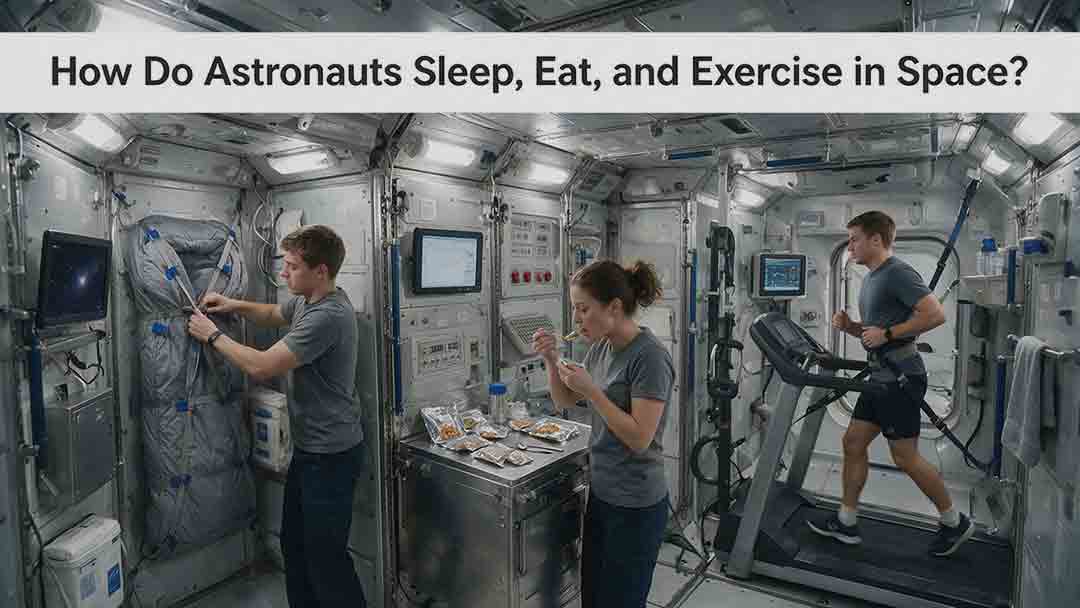
Astronauts sleep in secured bags inside ventilated crew quarters, eat packaged meals that can be eaten directly, rehydrated, or warmed, and exercise with resistance, treadmill, and cycling equipment. These adaptations keep people and food controlled in microgravity, support rest and nutrition, and help reduce the muscle, bone, cardiovascular, and balance changes associated with long-duration spaceflight.
Key Takeaways
- Astronauts secure their sleeping bags because there is no mattress pressure or natural “down” direction in microgravity.
- Space meals are recognizable foods packaged to control crumbs, liquid, storage life, preparation time, and waste.
- NASA sources may describe about two hours of active exercise or a longer scheduled block that includes setup and related tasks.
- Resistance exercise, treadmill running, and cycling address different physical risks; no single machine replaces all three.
- Sleep, nutrition, and exercise work together as one crew-health system, but they do not eliminate every effect of spaceflight.
This article explains what astronauts actually do, why the routines are necessary, how the main equipment works, and which details depend on the spacecraft and mission.
Why Do Ordinary Routines Work Differently in Microgravity?
Microgravity removes the familiar body-weight forces that organize everyday life on Earth.
Astronauts on an orbiting spacecraft are not beyond Earth’s gravity. The spacecraft, crew, food, and equipment are all falling around Earth together. NASA describes this condition as free fall, which makes people and objects appear nearly weightless inside the vehicle.
This is why astronauts can float rather than stand on a floor. It is also why a bed, dinner plate, barbell, or ordinary treadmill cannot be used in exactly the same way it is used on Earth.
NASA’s overview of microgravity explains why orbiting crews and objects appear nearly weightless even though Earth’s gravity is still acting on them.
Earth Routine vs. Spacecraft Solution
The table below is an original comparison designed to show not only the solution used in space, but also the limitation that remains.
| Earth routine | Microgravity problem | Spacecraft solution | Remaining limitation |
|---|---|---|---|
| Sleeping on a mattress | The body does not remain pressed against a bed | Secure a sleeping bag inside a ventilated sleep area | Noise, light, temperature, airflow, and schedule still affect sleep |
| Eating from a plate | Food pieces and liquid can drift | Use sealed packages, controlled openings, utensils, and restraints | Packaging waste and limited fresh-food storage remain |
| Drinking from a cup | Liquid does not settle at the bottom | Use a sealed drink pouch or a specially shaped capillary cup | Handling liquids still requires control |
| Lifting weights | A freely floating weight does not provide normal downward loading | Generate resistance mechanically | Equipment can be large, complex, and maintenance-intensive |
| Running outdoors | The runner does not stay on the ground | Use a harness to hold the runner against a treadmill | Harness loading differs from normal body weight |
| Riding a bicycle | The rider cannot rely on body weight to remain on the seat | Use foot restraints, handholds, and pedal resistance | Cycling provides limited impact loading for bones |
The same principle appears in all three routines: when gravity no longer supplies a useful force, the spacecraft must replace it with restraints, airflow, packaging, or mechanical resistance.
How Do Astronauts Sleep in Space?
Astronauts normally sleep in secured sleeping bags inside compact crew quarters or designated sleeping areas.
The sleeping bag prevents uncontrolled drifting and helps the astronaut maintain a comfortable, predictable position. It does not need to support the body’s weight in the way a mattress does on Earth.
There is no meaningful physical difference between sleeping upright, sideways, or “on the ceiling” in microgravity. Orientation mainly depends on cabin layout, equipment placement, airflow, and individual comfort.
NASA’s International Space Station overview, reviewed for this article on August 1, 2026, lists six sleeping quarters aboard the station. The available arrangement can still depend on crew size and mission operations. See NASA’s International Space Station Overview.
What Is Inside an Astronaut’s Sleeping Area?
A crew sleeping area may include:
- A secured sleeping bag
- Ventilation openings
- Adjustable lighting
- A laptop or small display
- Communication equipment
- Storage for a limited number of personal items
- Restraints or attachment points for loose objects
The space is compact, but privacy matters during a mission in which the same vehicle serves as a laboratory, home, gym, dining area, and workplace.
Ventilation is a safety and comfort requirement rather than an optional convenience. Warm exhaled air does not naturally rise away from a person’s face in microgravity as it usually does on Earth.
NASA’s Sleep Accommodations Technical Brief states that adequate ventilation is needed to avoid unacceptable carbon dioxide levels and odors near the sleeper’s head.
The spacecraft’s wider air-revitalization system removes carbon dioxide while ventilation and air circulation prevent stagnant pockets near the crew. Oxygen supply, carbon dioxide removal, humidity control, and airflow therefore work as one coordinated cabin-environment system.
How Does an Astronaut Prepare for Sleep?
Procedures vary by vehicle and mission, but the practical sequence is generally straightforward:
Finish scheduled work and communications.
Mission schedules coordinate scientific work, maintenance, meals, exercise, conferences, hygiene, and rest.Secure loose objects.
Electronics, clothing, notebooks, and personal items must be restrained so they do not drift through the cabin.Check the sleep area.
Ventilation openings must remain clear, and floating items must not obstruct the sleeper or cabin equipment.Enter and secure the sleeping bag.
The bag is attached to the spacecraft structure. Some astronauts prefer a firm, restrained feeling, while others tolerate more freedom inside the bag.Reduce disruptive light and noise.
Cabin lighting, eye masks, approved hearing protection, and scheduled quiet periods may be used when mission conditions allow.Follow the planned wake time.
Crew members use alarms and the mission schedule rather than orbital sunrise to determine the start of the next work period.
This is a general educational summary, not an operational checklist for a specific spacecraft.
How Long Do Astronauts Sleep?
Astronauts are commonly given a sleep opportunity of roughly eight hours, but planned time and actual sleep are not the same measurement.
Several historical spaceflight studies found that astronauts slept an average of approximately six hours per night. NASA’s technical review How Do Humans Sleep in Space? explains that workload, environmental conditions, and circadian timing contributed to many earlier sleep problems.
A more recent NASA study using wrist-worn activity measurements reported an average of 7.33 hours of sleep per night among the studied crew members. The result came from a specific study population and should not be interpreted as a guaranteed result for every astronaut or mission. See Astronaut Sleep Duration Varies by Timing of Scheduled Sleep.
| Sleep figure | What it represents |
|---|---|
| About 8 hours | A commonly scheduled sleep opportunity |
| About 6 hours | An average reported across several historical studies |
| 7.33 hours | The mean recorded in a newer NASA study population |
| Individual sleep | Varies with timing, workload, environment, health, and mission events |
These figures are not necessarily contradictory. They describe different missions, research methods, schedules, and crew populations.
Why Do Astronauts Not Sleep at Every Orbital Sunset?
The International Space Station circles Earth approximately every 90 minutes and can pass through about 16 sunrises and sunsets during one 24-hour period.
That rapid cycle cannot function as a normal human day-night schedule. The crew instead follows a coordinated 24-hour timetable with planned work, meals, exercise, and sleep.
The European Space Agency’s explanation of sleep in orbit describes how repeated orbital sunrises and sunsets complicate natural circadian cues.
Circadian rhythm is the internal biological timing system that helps regulate sleep, alertness, hormone release, and other daily processes.
Artificial lighting, consistent routines, fatigue management, and carefully timed schedule changes help support this rhythm. Operational requirements such as dockings, emergency work, or changes in vehicle activity can still disrupt sleep.
What Makes Sleeping in Space Difficult?
| Challenge | Why it matters | Typical response |
|---|---|---|
| Lack of mattress pressure | Some people miss the sensation of lying on a surface | Tighten or reposition the sleeping bag |
| Equipment noise | Fans and life-support hardware operate continuously | Use quiet periods and approved hearing protection |
| Rapid light-dark cycles | Natural orbital light is not a useful daily clock | Follow a 24-hour schedule and manage cabin lighting |
| Schedule shifting | Dockings and critical operations may change sleep timing | Use planned fatigue-management measures |
| Poor local airflow | Exhaled carbon dioxide may remain near the face | Keep ventilation openings clear |
| Limited privacy | The spacecraft is a shared workplace and home | Use individual crew quarters where available |
| Temperature or humidity | Discomfort can interrupt sleep | Maintain the cabin environment through life-support and thermal systems |
Medication and other medical sleep countermeasures are managed by qualified flight medical teams. They are not general recommendations for readers on Earth.
How Do Astronauts Eat in Space?
Astronauts eat recognizable meals, but the food is selected and packaged for safety, storage life, nutrition, preparation limits, and controlled handling in microgravity.
Space food is not primarily made of pills, toothpaste-like tubes, or flavorless cubes. Those images are associated mainly with the early years of human spaceflight.
Modern menus can include meat, vegetables, rice, pasta, soups, fruit, desserts, snacks, condiments, coffee, tea, and other beverages. The exact menu depends on the mission, spacecraft, participating space agencies, available equipment, storage time, and individual dietary requirements.
NASA’s Space Food Systems program develops and evaluates menus, packaging, processing methods, food-related hardware, and longer-duration food technologies.
Which Types of Space Food Are Common?
| Food category | Preparation | Main advantage | Main limitation |
|---|---|---|---|
| Ready-to-eat | Open and eat directly | Requires little equipment or preparation time | Water remains in the product, adding mass |
| Rehydratable | Add a measured amount of water | Can reduce stored mass and volume for suitable foods | Requires water and preparation time |
| Thermostabilized | Heat-treated and sealed before flight | Long shelf life and broad meal selection | Processing may change texture or flavor |
| Irradiated | Treated under controlled conditions to reduce harmful microorganisms | Supports food safety for selected products | Used selectively and requires specialized processing |
| Powdered beverage | Add water through a sealed valve | Compact and easy to contain | Depends on a safe water supply |
| Natural-form food | Eat with little or no preparation | Familiar texture and convenience | Shelf life varies |
| Fresh food | Eat relatively soon after delivery | Variety, texture, and crew enjoyment | Perishable and dependent on resupply |
For Artemis II, NASA describes food aboard Orion as ready-to-eat, rehydratable, thermostabilized, or irradiated. The crew uses a potable-water dispenser and a compact food warmer when those resources are available. See Artemis II: What’s on the Menu?.
How Is a Space Meal Prepared?
A meal may be prepared through the following steps:
Choose a package from the available menu.
Selection must remain consistent with mission nutrition and food-handling requirements.Identify the preparation method.
Some items can be eaten immediately. Others require water, warming, or a waiting period.Add water when required.
A dispenser delivers a measured amount through a valve in the package.Allow the food to rehydrate.
The required time depends on the product.Warm suitable items.
A spacecraft food warmer heats packages but does not function like a full household kitchen.Secure the meal and utensils.
Hook-and-loop fasteners, restraints, or trays can help keep packages and tools within reach.Open the package carefully.
A controlled opening reduces the chance of droplets or food pieces escaping.Eat directly from the package.
The package acts as the bowl or plate.Contain the waste.
Empty packages, wipes, and other meal waste must be stored for later disposal.
The exact sequence depends on the spacecraft. A short-duration capsule may offer fewer food-preparation options than the International Space Station.
Why Are Tortillas Common in Space?
Tortillas are useful because they can hold fillings without producing the loose crumbs associated with ordinary bread.
Floating crumbs may enter equipment, interfere with experiments, or irritate a crew member’s eyes, nose, or mouth. Food that behaves well in a kitchen on Earth may therefore create avoidable work in a spacecraft.
NASA’s history of Food on the International Space Station explains how tortillas became standard space food after crews recognized their practical advantages.
This does not mean every crumb would cause an emergency. The point is that minimizing free-floating debris makes the cabin easier and safer to manage.
How Do Astronauts Drink Liquids?
Most drinks are mixed and consumed from sealed packages through a straw or valve. The package prevents the liquid from separating into free-floating blobs.
Ordinary cups are unreliable because liquid does not settle at the bottom. Surface tension may cause it to cling to a container rather than flow naturally toward the drinker.
Special capillary cups can use container shape, wetting, and surface tension to guide liquid toward the rim. NASA explains this design in A Zero-Gravity Cup for Drinking Beverages in Microgravity.
The specialized cup is a useful experiment and design demonstration, but sealed drink packages remain the more typical practical solution.
Does Food Taste Different in Space?
Some astronauts report changes in appetite or flavor preference, but the experience is not identical for everyone.
Early in a mission, fluid shifts toward the upper body can create a congested sensation. Because smell contributes strongly to flavor, a stuffy-nose-like feeling may make some foods seem less intense.
Cabin odors, meal temperature, texture, stress, workload, and individual preference can also affect food appeal. It is therefore too simple to say that “taste buds stop working in space.”
NASA discusses these factors in Taste in Space and How Does Spaceflight Change Food Appeal?.
Some crew members prefer hot sauces or strongly flavored foods, but this is a preference pattern rather than a universal biological rule.
How Can a Space Food System Be Evaluated?
The following SAFE framework is an original editorial tool for explaining why some foods are better suited to spacecraft than others. It is not a NASA standard.
Stability
Will the food remain microbiologically safe, nutritionally useful, and acceptable throughout the required storage period?
Access
Can the crew prepare it with the water, power, time, equipment, and cabin space available during that mission phase?
Float Control
Can the food be opened, handled, and eaten without releasing excessive crumbs, droplets, powders, or loose pieces?
Eating Value
Does the food provide useful nutrition, acceptable flavor, variety, and enough appeal for crew members to consume it consistently?
A food can perform well in one category and poorly in another. For example, a lightweight dehydrated meal may save launch mass but require water and preparation time. A highly stable food may still be ineffective if crew members regularly avoid eating it.
What Tradeoffs Shape a Space Menu?
| Priority | Benefit | Cost or limitation |
|---|---|---|
| Long storage life | Supports long missions and delayed use | Flavor, texture, and some nutrients may change over time |
| Low launch mass | Reduces transportation requirements | Some foods require onboard water |
| Fast preparation | Protects crew working time | Limits meal complexity |
| Strong packaging | Controls contamination and leakage | Produces solid waste |
| Menu variety | Supports intake, morale, and cultural preferences | Increases planning and storage complexity |
| Fresh items | Improve texture and variety | Short shelf life and dependence on delivery |
| Familiar foods | Provide comfort and encourage eating | May not meet every spacecraft constraint |
Food also has a social role. Shared meals give crew members a chance to pause, talk, and maintain a sense of normal life inside a demanding work environment.
NASA notes that crew members may supplement parts of the standard menu with approved personal favorites. See NASA Space Food Systems.
How Do Astronauts Exercise in Space?
Astronauts exercise because floating around a spacecraft does not provide the repeated loading that muscles, bones, and the cardiovascular system receive during ordinary life on Earth.
Standing, walking, climbing stairs, and carrying objects constantly load the body under Earth gravity. In microgravity, the lower body no longer performs the same support work.
Exercise is therefore an operational and medical countermeasure, not simply recreation.
NASA documentation reviewed on August 1, 2026, identifies three primary exercise systems used regularly by NASA astronauts aboard the International Space Station:
- The Advanced Resistive Exercise Device, or ARED
- The T2 treadmill
- The Cycle Ergometer with Vibration Isolation and Stabilization System, or CEVIS
See NASA’s Astronaut Exercise overview.
How Much Time Do Astronauts Spend Exercising?
NASA sources commonly describe astronauts as exercising for about two hours per day. Other NASA material describes a scheduled exercise block of approximately two and a half hours.
These figures do not necessarily conflict. One source may describe active workout time, while a scheduled block can include equipment configuration, changing restraints, cleaning, data recording, and related activities.
NASA’s Astronaut Exercise page describes the approximately two-hour routine. NASA’s Astronaut Health Care FAQ describes a two-and-a-half-hour scheduled block.
The exact prescription varies with the astronaut, mission phase, equipment status, medical requirements, and daily operations.
Which Exercise Machine Does What?
| Equipment | Primary role | How it works | Important limitation |
|---|---|---|---|
| ARED | Strength and musculoskeletal loading | Uses mechanical resistance rather than gravity-loaded metal weights | Large and mechanically complex |
| T2 treadmill | Running, walking, and cardiovascular exercise | A harness holds the astronaut against the belt | Harness forces do not feel identical to body weight |
| CEVIS | Controlled aerobic exercise | Pedal resistance creates workload while restraints stabilize the rider | Provides less impact loading than running |
No single machine reproduces normal life on Earth. The equipment suite combines different forms of loading and cardiovascular work.
How Does ARED Replace Ordinary Weights?
A conventional barbell still has mass in space, but it does not remain pulled toward a floor while floating inside the spacecraft. Simply lifting it up and down would not reproduce normal weight training.
ARED generates resistance mechanically. NASA describes the device as using vacuum cylinders and flywheel-based mechanisms to support exercises that resemble squats, deadlifts, heel raises, presses, and other resistance movements.
The device helps load muscles and bones that would otherwise receive much less mechanical stress.
How Can Astronauts Run on a Treadmill?
A harness and restraint system pulls the astronaut toward the treadmill belt.
Without that restraint, each step would push the astronaut away from the machine. The harness supplies a substitute loading force, allowing repeated foot contact with the belt.
The experience is not identical to running on Earth. Harness pressure, altered movement mechanics, individual comfort, and the selected loading force can all affect the workout.
Why Is Cycling Useful If It Does Not Load the Bones as Much?
CEVIS provides a controlled cardiovascular workout without requiring the same harness forces used on a treadmill.
Cycling can challenge the heart, lungs, blood vessels, and working muscles while allowing workload to be adjusted and measured. It also gives the crew an aerobic option when treadmill use is not appropriate or desirable.
Its limitation is that cycling does not reproduce the same impact or foot-loading pattern as running. This is why it complements rather than replaces resistance and treadmill exercise.
What Happens During a Typical Exercise Session?
The detailed prescription is individualized by qualified specialists, but a general session follows this pattern:
Review the assigned workout.
The plan identifies the equipment, workload, movements, duration, and monitoring requirements.Configure the machine.
The astronaut adjusts resistance, pedals, handles, harnesses, foot restraints, or other hardware.Secure the body.
Restraints prevent the astronaut from drifting away or moving unpredictably.Perform the workout.
The session may emphasize resistance, aerobic conditioning, or both.Monitor the effort.
Equipment or wearable systems may record workload, heart rate, speed, repetitions, or other approved measurements.Clean and inspect the equipment.
Sweat, repeated loading, vibration, and moving components make maintenance important.Record the session.
The data can help conditioning teams evaluate the program and adjust later workouts.
This description is educational. It is not a training prescription for the public or an operational procedure for flight hardware.
Why Are Bones and Muscles at Risk?
Weight-bearing bones and postural muscles normally respond to repeated loading. When that loading falls sharply, the body begins adapting to the new environment.
NASA reports that, on average, some weight-bearing bones lost approximately 1% to 1.5% of mineral density per month during four-to-six-month missions represented in the cited evidence. Loss varies by skeletal site, individual, mission duration, and countermeasure effectiveness.
See NASA’s Risk of Spaceflight-Induced Bone Changes.
Muscles can also become smaller or weaker when they no longer need to support normal body weight. Cardiovascular and balance systems adapt as well.
Does Exercise Prevent Every Physical Change?
No. Exercise reduces risk and helps preserve function, but it does not make long-duration microgravity harmless.
Crew members can still experience changes in bone, muscle, aerobic capacity, circulation, balance, movement control, and other systems.
The amount of change depends on factors such as:
- Mission duration
- Exercise adherence
- Starting fitness
- Individual physiology
- Nutrition
- Equipment availability
- Exercise intensity and loading
- Illness, injury, or medical restrictions
- The gravity environment before and after flight
NASA continues to study exercise hardware, training prescriptions, nutrition, medications, and combined countermeasures.
What Are the Three Jobs of a Space Workout?
A useful way to understand the exercise program is to divide its purpose into three functions:
- Load: Apply resistance to muscles and bones that no longer support normal body weight.
- Pump: Challenge cardiovascular and aerobic systems.
- Practice: Maintain movement capacity needed for work, emergencies, landing, and readaptation to gravity.
This Load–Pump–Practice summary is an editorial explanation, not an official NASA classification.
A cycling-only program would provide limited skeletal loading. A resistance-only program would not fully address aerobic fitness. A complete countermeasure program therefore uses complementary types of exercise.
How Do Sleep, Food, and Exercise Affect One Another?
These activities are best understood as a connected recovery system.
Exercise provides a reason for muscles, bones, and the cardiovascular system to remain active. Food provides energy and nutrients. Sleep supports alertness, coordination, learning, decision-making, and recovery.
A weakness in one part can affect the others:
- Poor sleep may reduce alertness and workout quality.
- Inadequate food intake may reduce energy and recovery.
- Poor food acceptance may cause a technically adequate menu to fail in practice.
- Inadequate exercise may accelerate physical deconditioning.
- Excessive workload may reduce time available for meals, exercise, or sleep.
- Physical discomfort may disturb sleep and reduce appetite.
This does not mean one difficult night or missed workout will automatically cause harm. The important issue is the pattern across a mission.
An Illustrative 24-Hour Time Budget
Consider a simplified day containing:
- 8 hours available for sleep
- 2 hours of active exercise
- 24 total hours
The calculation is:
24 hours − 8 hours of sleep − 2 hours of exercise = 14 hours remaining.
Those 14 hours must accommodate scientific work, spacecraft maintenance, meals, hygiene, medical activities, planning conferences, communications, equipment setup, emergencies, recreation, and personal time.
This is an editorial illustration, not a published astronaut timetable. Real schedules vary from day to day and may treat setup or cleaning time differently.
The example shows why schedule design matters. Even routines that sound simple can consume a large portion of the crew’s limited time.
How Do These Routines Change Between Missions?
The core human needs remain the same, but the available hardware can differ greatly.
| Mission environment | Sleep | Food | Exercise |
|---|---|---|---|
| International Space Station | Dedicated crew quarters and secured sleeping bags | Broad packaged menu with water and warming equipment | ARED, T2, and CEVIS |
| Short-duration capsule | Limited privacy and compact sleeping arrangements | Simpler meals matched to mission phases | Little room for large exercise machines |
| Lunar transit or surface mission | Systems must account for vehicle size and partial gravity | Storage life, waste, water, and preparation remain major constraints | Smaller systems may be required |
| Mars transit | Long-duration privacy, noise, and circadian management become critical | Multi-year acceptability and food stability become major risks | Highly reliable, compact countermeasures are necessary |
| Mars surface habitat | Partial gravity changes movement but does not reproduce Earth loading | Stored food may be supplemented by future food-production research | Surface work and exercise may both contribute to physical loading |
The future-mission rows summarize publicly discussed research directions and likely design pressures. They are not confirmed specifications for a particular Moon or Mars vehicle.
Mission planners must decide how much mass, volume, power, water, maintenance time, and crew time each system can use. Improving one factor may make another more difficult.
For example:
- A more capable food warmer may increase power use.
- A compact exercise machine may not reproduce every function of the ISS equipment suite.
- A larger sleeping compartment may improve privacy but reduce space available for other systems.
- Longer-lasting food may sacrifice some texture or menu variety.
- Greater treadmill loading may improve the stimulus while reducing comfort.
“Astronauts Can Simply Float Anywhere to Sleep”
An astronaut may be able to fall asleep while floating, but uncontrolled movement is inconvenient and may lead to contact with equipment. A designated sleeping area also provides airflow, privacy, lighting control, and storage.
“Astronauts Sleep Standing Up”
Standing is an Earth-gravity description. In microgravity, an astronaut secured vertically relative to the spacecraft is not supporting body weight through the feet.
“Space Food Is Mostly Pills”
Modern crews eat varied meals in packaged forms. Pills cannot replace the energy, protein, carbohydrates, fats, water, fiber, menu variety, and social value of a complete food system.
“Food Will Float Out of an Astronaut’s Stomach”
Digestion does not depend only on gravity. Muscular contractions called peristalsis move material through the digestive tract.
“Astronauts Cannot Use Cups”
Ordinary cups do not behave normally, but specially designed capillary cups can guide liquid toward the rim through surface tension and container shape. Sealed drink packages remain more common.
“Astronauts Lift Normal Barbells”
A freely floating barbell does not produce ordinary downward weight. ARED must generate resistance mechanically.
“Two Hours of Exercise Cancels Out Microgravity”
Exercise is a major countermeasure, but physical changes can still occur. It reduces risk; it does not guarantee complete protection.
“The Crew Sleeps Every Time the Station Enters Darkness”
The station enters darkness repeatedly during each 24-hour period. Astronauts follow a coordinated daily schedule instead.
How Can Readers Evaluate Claims About Astronaut Routines?
Before accepting a claim about sleeping, food, or exercise in space, check:
Is the spacecraft identified?
ISS practices should not automatically be applied to Orion, a short-duration capsule, or a future Mars vehicle.Is the mission period identified?
Equipment and procedures can change.Is a number planned or measured?
Scheduled sleep is not the same as recorded sleep. A scheduled exercise block is not necessarily all active workout time.Does the source support the exact claim?
A general NASA page should not be used as evidence for a precise figure it never states.Is individual experience being presented as universal?
One astronaut’s preference does not establish how every astronaut sleeps or eats.Does the claim distinguish microgravity from no gravity?
Are future systems described as research directions or confirmed hardware?
Does the source come from NASA, ESA, another responsible agency, a university, or peer-reviewed research?
Is the publication or review date visible?
Does the article acknowledge remaining limitations?
What Should Different Readers Do Next?
Students: Compare one Earth activity with its spacecraft replacement. Focus on which role gravity normally performs and how equipment replaces it.
Teachers: Use the Earth-versus-space table to build a lesson about force, airflow, fluid behavior, nutrition, or human physiology.
Human-spaceflight readers: Compare how microgravity affects bones, muscles, fluid distribution, balance, and vision, and note which countermeasures reduce risk without eliminating it.
Spacecraft-systems readers: Trace how oxygen supply, carbon dioxide removal, airflow, humidity control, water, waste handling, and food storage support daily crew routines.
Engineering readers: Compare crew routines with spacecraft power and thermal budgets, especially because people and exercise equipment add heat to an enclosed cabin and life-support hardware also consumes electrical power.
What Is the Practical Conclusion?
Astronauts do not stop needing sleep, meals, movement, privacy, and recovery when they enter space. Instead, spacecraft designers must rebuild the physical conditions that make those routines manageable.
Sleeping bags replace the stabilizing pressure of a bed. Sealed packages replace plates and open cups. Mechanical resistance and body restraints replace part of the loading normally supplied by gravity.
The systems work well enough to support long missions, but each carries limits. Sleep can still be disrupted, food still has storage and acceptability constraints, and exercise cannot prevent every physiological change.
Understanding those remaining limits is more useful than treating life in space as either effortless floating or constant danger.
Can astronauts sleep in any direction?
Yes. Microgravity does not create a normal up or down inside the spacecraft. A sleeping bag can be attached in different orientations as long as the location provides safe restraint, clearance, and adequate airflow.
Do astronauts use pillows?
A conventional pillow is not required because the head does not press downward under body weight. Some astronauts may use padding or restraints for comfort, but the arrangement varies.
Do astronauts eat three meals every day?
Crew schedules normally include regular meal periods, and food is available for meals and snacks. Exact timing and intake vary with individual needs and mission operations.
Can astronauts cook food from raw ingredients?
Most spacecraft do not provide a conventional kitchen. Meals are usually prepared, processed, or packaged before launch and then eaten directly, rehydrated, or warmed. Future exploration missions may study additional food-production methods, but these should not be confused with current ISS meal preparation.
Do astronauts exercise every day?
Exercise is a regular part of long-duration missions. NASA sources describe approximately two hours of exercise per day, although individual schedules can change because of operations, medical needs, equipment availability, or rest requirements.
Can astronauts walk normally immediately after landing?
Not always. After long exposure to microgravity, returning astronauts may experience weakness, dizziness, lightheadedness, nausea, or balance problems while the body readapts to gravity. Recovery varies by individual and mission duration. NASA discusses this process in Life After Microgravity.
Sources and Editorial Approach
This guide is based on publicly available NASA and ESA documentation, NASA Technical Reports Server records, mission information, and clearly identified editorial comparison frameworks.
It does not represent firsthand spaceflight experience, medical advice, or vehicle-specific operational guidance. Numerical claims were checked against the linked sources available on the review date. Future-mission examples are labeled as research directions or design pressures rather than confirmed specifications.
Sources accessed or rechecked August 1, 2026:
NASA — Astronaut Exercise
Supports the descriptions of ARED, T2, CEVIS, and the approximate daily exercise routine.NASA — Astronaut Strength, Conditioning and Rehabilitation
Supports the identification of the three main ISS exercise systems and the role of conditioning.NASA — The Real Story About Astronaut Health Care in Space
Supports the distinction between active exercise and a larger scheduled exercise period.NASA — Space Food Systems
Supports information about menu development, packaging, food production, personal preferences, and long-duration food research.NASA — Artemis II: What’s on the Menu?
Supports the Orion food categories, water dispenser, and compact food warmer.NASA — Food on the International Space Station
Supports the explanation of tortillas and crumb control.NASA — International Space Station Overview
Supports the station’s listed sleeping quarters, gym, and orbital frequency.NASA — What Is Microgravity?
Supports the explanation of orbital free fall and apparent weightlessness.NASA — Risk of Spaceflight-Induced Bone Changes
Supports the reported average bone-density change in weight-bearing bones during the cited mission range.NASA Technical Reports Server — Astronaut Sleep Duration Varies by Timing of Scheduled Sleep
Supports the reported average of 7.33 hours of sleep in the studied crew population.NASA Technical Reports Server — How Do Humans Sleep in Space?
Supports the historical sleep findings and the role of environment and circadian timing.NASA — Sleep Accommodations Technical Brief
Supports the importance of ventilation, noise control, lighting, privacy, temperature, and sleep-space design.ESA — A Good Night’s Sleep in Orbit
Supports the approximate 90-minute orbit and repeated daily sunrises and sunsets.NASA — How Does Spaceflight Change Food Appeal?
Supports discussion of food appearance, flavor, texture, aroma, and acceptability.NASA Technical Reports Server — A Zero-Gravity Cup for Drinking Beverages in Microgravity
Supports the explanation of specialized cup geometry and capillary liquid control.NASA — Life After Microgravity
Supports the discussion of individual variation and post-flight readaptation.
Editorial method: The editorial process compared official NASA and ESA materials, checked numerical statements against the linked agency or research records, and separated mission-specific facts from editorial comparison tools. No independent medical or aerospace-engineering review is claimed.
More from Human Spaceflight
How Do Spacecraft Return Safely Through Earth’s Atmosphere?
Spacecraft return safely through Earth’s atmosphere by managing an enormous amount of energy through a carefully coordinated sequence of trajectory control, thermal protection, aerodynamic deceleration, landing, and recovery. This article explains how deorbit burns and entry corridors guide a spacecraft toward its landing region, why blunt heat shields reduce the danger of hypersonic heating, and how guidance systems control attitude, range, and structural loads. It includes an original comparison of low-Earth-orbit and lunar-return energy, a practical review of ablative and reusable heat-shield technologies, and the CosmoBasics Four-Layer Reentry Framework covering path, protection, control, descent, and recovery. Real-world lessons from Artemis I and the crewed Artemis II mission show why postflight inspection remains essential even after a successful splashdown. Readers will also learn how parachutes, wings, landing rockets, flotation systems, and recovery teams complete the return safely.
What Happens to the Human Body in Microgravity?
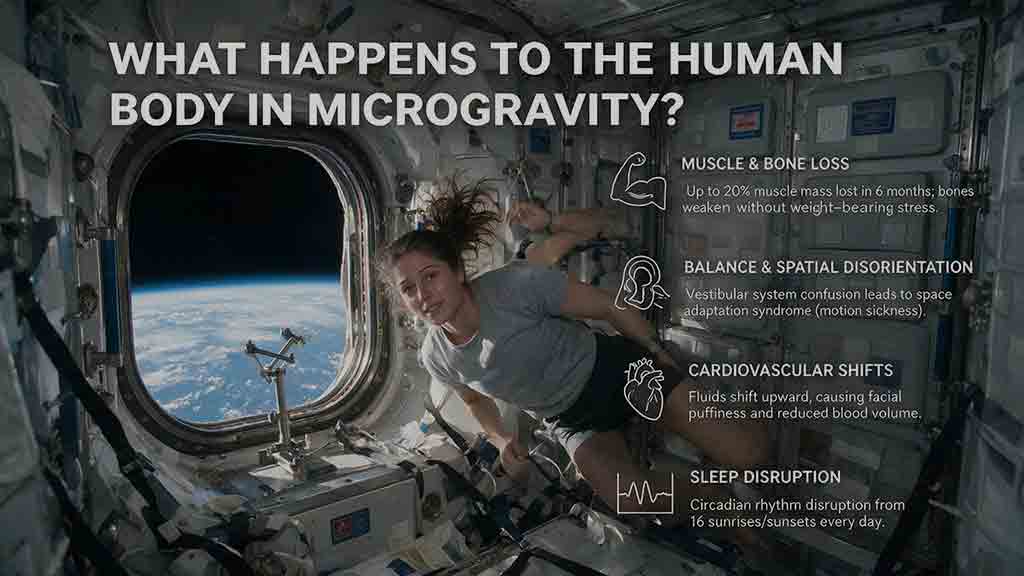
Microgravity changes the human body because fluids are no longer pulled toward the legs, muscles and bones receive less mechanical loading, and the brain loses gravity as a dependable orientation signal. This article explains how weightlessness affects balance, circulation, muscle strength, bone density, vision, blood, immunity, digestion, sleep, and spinal length. It also examines why astronauts may struggle to stand or walk after landing and how exercise, nutrition, monitoring, and rehabilitation help reduce these risks. Two original tools—the Load–Flow–Orientation Framework and the Gravity-Transition Readiness Matrix—connect physiological changes with real mission demands. Drawing on NASA standards, NASA technical reports, ESA materials, and peer-reviewed human spaceflight research, the guide clearly separates established observations from experimental countermeasures and unresolved questions. It also explains what these effects could mean for future missions to the Moon and Mars without treating population averages as predictions for individual astronauts.
How Does a Spacecraft Life Support System Work?
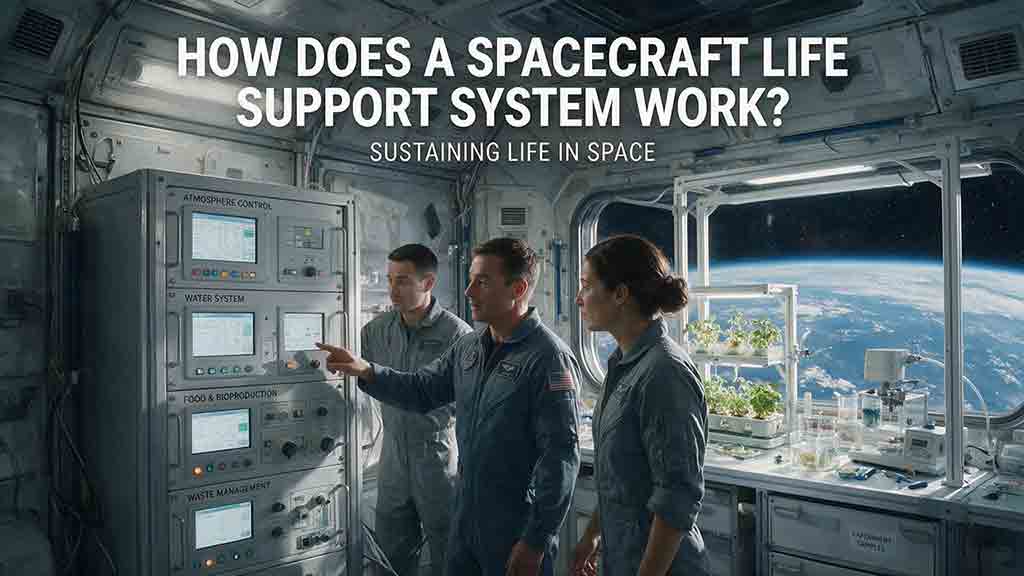
A spacecraft life support system creates and maintains a safe cabin environment for astronauts by managing oxygen, carbon dioxide, air pressure, ventilation, temperature, humidity, water, waste, and environmental hazards. This article explains how the Environmental Control and Life Support System connects these functions into continuous air, water, heat, and waste-management loops. It compares stored-resource and regenerative designs, examines how the International Space Station and Orion use different life support architectures, and clarifies what NASA’s reported 98% water-recovery milestone actually means. Readers will also find an educational water-use calculation, a high-level architecture checklist, a system-failure comparison table, and the original Four-C framework for evaluating Crew, Calendar, Cargo, and Consequences. The guide relies on NASA and European Space Agency sources while clearly separating official facts, illustrative estimates, and independent editorial analysis.
Explore More Topics
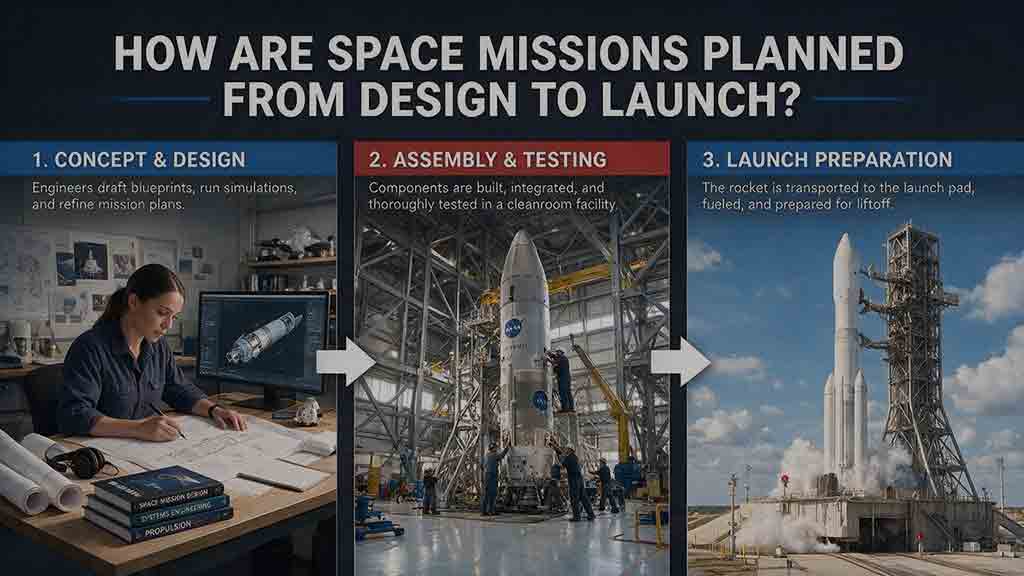
How Are Space Missions Planned From Design to Launch?
Space missions are planned by transforming a scientific, commercial, or exploration goal into a complete system that can be designed, built, tested, launched, operated, and responsibly concluded. This guide follows the full planning lifecycle, from defining measurable objectives and comparing mission concepts to writing requirements, selecting an architecture, managing resource budgets, and controlling interfaces. It explains how payloads, spacecraft platforms, trajectories, launch services, software, ground systems, regulations, and operations must be developed together. Readers will also learn how design reviews, fabrication, environmental testing, end-to-end verification, operator training, licensing, launch integration, and readiness assessments support mission development. Original planning frameworks, worked mass, power, and data calculations, troubleshooting guidance, and a practical checklist show how teams identify weak assumptions and resolve designs that do not close. The central lesson is that mission readiness depends on the entire technical and operational system—not merely on completing the spacecraft.
What Happens During a Rocket Launch Countdown?
A rocket launch countdown is far more than a clock running toward zero. It is a carefully coordinated process that brings the launch vehicle, spacecraft, ground equipment, flight teams, weather conditions, and safety range into an approved configuration for liftoff. This article explains the major countdown phases, including launch-pad preparation, propellant loading, avionics and navigation checks, weather monitoring, range clearance, go/no-go polls, and terminal count. It also clarifies commonly misunderstood terms such as T-minus, L-minus, planned hold, recycle, scrub, and launch window. An original Four-C Countdown Framework—Clock, Configuration, Constraint, and Commitment—helps readers understand why teams may continue, pause, return to an earlier step, or cancel a launch attempt. Practical timelines, comparison tables, a launch-window calculation, and a viewer’s checklist make the article useful for students, educators, first-time launch viewers, and spaceflight enthusiasts.
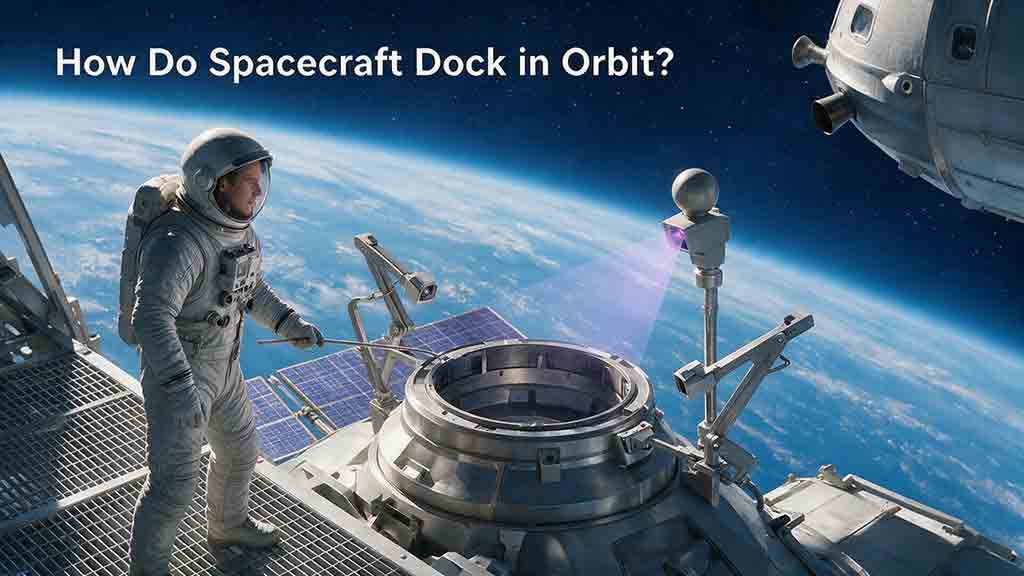
How Do Spacecraft Dock in Orbit?
Spacecraft docking is a carefully controlled process that begins long before two vehicles make physical contact. The approaching spacecraft must first establish compatible orbital geometry, adjust its timing through phasing maneuvers, and reduce differences in position, velocity, and orientation. This guide explains the complete sequence from far-field rendezvous and relative navigation to hold points, final approach, soft capture, and hard capture. It also compares docking with robotic berthing, examines the sensors and control systems used during an approach, and shows how mission teams respond when navigation data, closing rates, or alignment fall outside permitted limits. A simplified orbital calculation demonstrates why a spacecraft in a slightly lower orbit can gradually catch its target. Readers will also find an original five-match framework, a practical docking-safety model, real mission examples, and a checklist for evaluating docking plans. The article clearly distinguishes educational principles from vehicle-specific flight procedures and engineering requirements.