Liquid-Fuel vs Solid-Fuel Rockets Explained

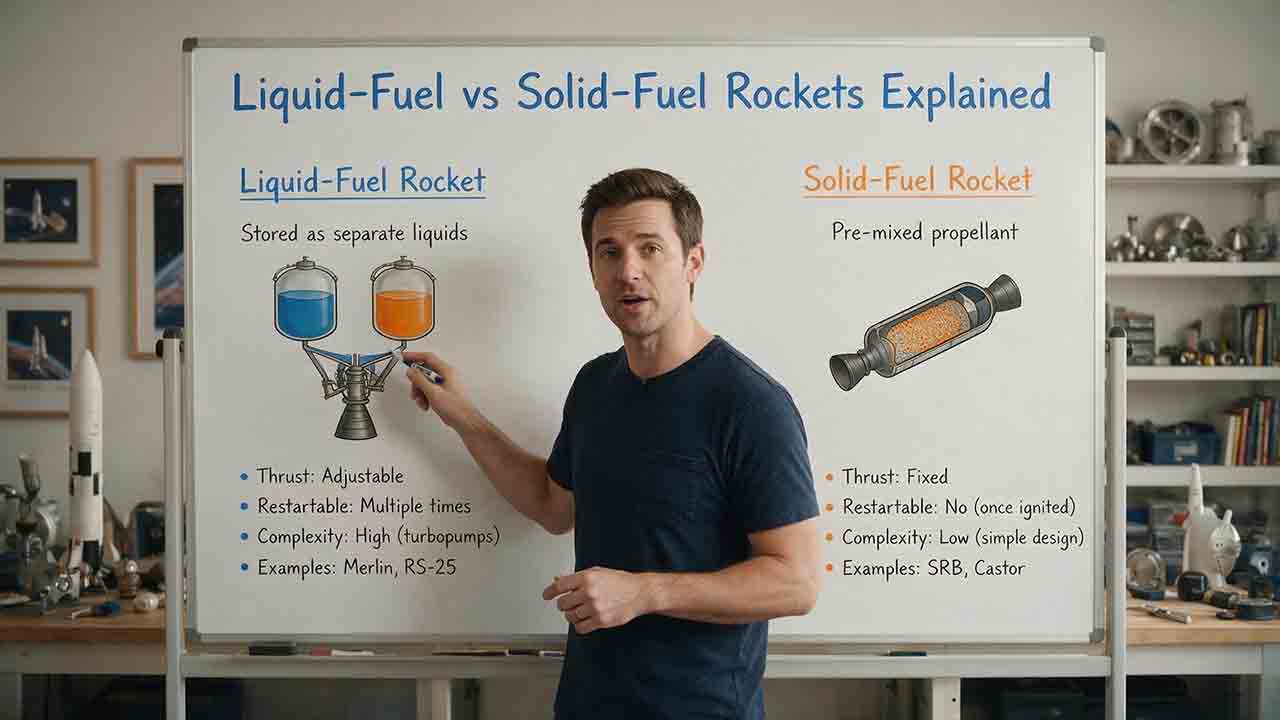
Liquid-Fuel vs Solid-Fuel Rockets Explained
Liquid-fuel rockets store fuel and oxidizer separately, giving engineers greater control over thrust, shutdown, and restart. Solid-fuel rockets store both components in a prepared solid propellant, making the propulsion system compact and capable of producing high thrust with fewer active parts. Neither type is universally better: the right choice depends on the stage’s job, required control, storage needs, mass, cost, and mission risk.
Key Takeaways
- Liquid rocket engines usually offer more active control, including planned shutdown, throttling, and sometimes multiple restarts.
- Solid rocket motors can package substantial propellant and high liftoff thrust into a comparatively compact system.
- High thrust does not automatically mean high efficiency; thrust and specific impulse measure different aspects of performance.
- Solid propulsion has fewer active feed-system components, but manufacturing, inspection, bonding, and structural integrity remain demanding.
- Many launch vehicles combine solid boosters with liquid core or upper stages because different phases of flight reward different propulsion characteristics.
This article will help readers understand how liquid and solid propulsion work, compare their practical trade-offs, interpret performance claims, and decide which technology better fits a particular launch-stage role.
Safety and scope: This article provides a high-level educational comparison. It does not include propellant formulas, propellant-production methods, motor-construction instructions, ignition procedures, pressure-vessel designs, engine-manufacturing steps, or operational launch guidance.
How Do Liquid-Fuel and Solid-Fuel Rockets Work?
The fundamental difference is how the propellant is stored and delivered.
In rocket engineering, propellant refers to the material or materials carried by the vehicle to produce thrust. Chemical rockets normally carry both fuel and oxidizer because they cannot rely on atmospheric oxygen at high altitude or in space.
How Does a Liquid Rocket Engine Work?
A liquid rocket engine stores fuel and oxidizer in separate tanks. Valves, feed lines, injectors, and either pumps or tank pressure move the liquids into a combustion chamber.
The propellants react inside the chamber, producing hot, high-pressure gas. A nozzle accelerates that gas backward, and the reaction force pushes the rocket forward.
Because engineers can regulate the flow of liquid propellants, a liquid engine may be designed to:
- Change thrust during a burn
- Shut down at a planned time
- Restart after a coast period
- Adjust its operating mixture
- Control several engines independently
- Perform separate burns for orbital insertion or landing
These capabilities are design-dependent. A liquid engine is not automatically throttleable, reusable, or restartable.
NASA’s Liquid Rocket Engine overview explains the basic storage, feed, combustion, and nozzle arrangement.
How Does a Solid Rocket Motor Work?
A solid rocket motor stores fuel and oxidizer together in a prepared solid propellant inside a casing. When the exposed propellant surface is ignited, it produces hot gas that flows through a nozzle and creates thrust.
The shape of the internal burning surface influences how thrust changes during the burn. Engineers can therefore design a motor to produce a rising, falling, or relatively steady thrust profile.
That profile is largely established before flight. A conventional large solid motor normally continues burning until its usable propellant is exhausted rather than stopping when a valve closes.
NASA’s Solid Rocket Engine overview describes this operating principle.
What Are the Main Differences Between Liquid-Fuel and Solid-Fuel Rockets?
| Comparison factor | Liquid rocket engine or stage | Solid rocket motor or stage |
|---|---|---|
| Propellant arrangement | Fuel and oxidizer stored separately | Fuel and oxidizer combined in solid propellant |
| Delivery system | Tanks, valves, pipes, injectors, and often pumps | Propellant burns inside the motor casing |
| Thrust control | Often adjustable, depending on engine design | Usually limited after ignition |
| Planned shutdown | Commonly possible by stopping propellant flow | Normally unavailable during a conventional burn |
| Restart | Available on engines designed and qualified for it | Uncommon for conventional large solid motors |
| Mechanical architecture | More active components and fluid systems | Fewer active feed-system components |
| Main manufacturing challenges | Pumps, valves, seals, injectors, plumbing, tanks, and controls | Propellant quality, bonding, casing, insulation, joints, and nozzle integrity |
| Propellant density | Varies; some liquids require large tanks | Generally compact for the stored propellant mass |
| Storage requirements | Depend heavily on propellant type and temperature | Often suited to extended storage under controlled conditions |
| Common launch role | Core stages, upper stages, reusable first stages, spacecraft propulsion | Strap-on boosters, first stages, compact kick stages |
| Mission flexibility | High when throttling, cutoff, or restart is available | Lower once ignition occurs |
| Powered recovery | Well suited when restart and throttling are available | Usually requires a different recovery approach |
These are general tendencies, not universal rules. Individual propulsion systems may depart significantly from the table.
Which Type Produces More Thrust?
Neither propulsion category always produces more thrust.
Thrust is the force generated by an engine or motor at a particular operating point. Both liquid engines and solid motors can be built across a wide range of sizes.
Large solid boosters are especially useful when a heavy launch vehicle needs substantial thrust immediately after liftoff. NASA states that the twin solid boosters on the Space Launch System provide more than 75% of the vehicle’s total thrust at launch. See NASA’s SLS Solid Rocket Booster reference.
Liquid propulsion can also generate very high thrust. The Falcon 9 first stage, for example, uses nine Merlin liquid rocket engines burning liquid oxygen and rocket-grade kerosene.
A meaningful comparison must identify the object being measured:
- One liquid engine
- One solid rocket motor
- A complete booster
- An entire first stage
- All operating engines at liftoff
Comparing one motor with an entire multi-engine stage can produce a technically true but practically misleading conclusion.
The better question is:
Which propulsion system supplies the required thrust while satisfying the vehicle’s mass, control, volume, structural, operational, and safety requirements?
Thrust must be evaluated together with vehicle mass and gravity: at liftoff, the total upward thrust must exceed the vehicle’s weight, while later mission phases may prioritize efficiency and controllability over maximum thrust.
Which Type Is More Efficient?
Liquid propulsion often achieves higher propellant efficiency, particularly when high-performance liquid propellant combinations are used. That does not mean every liquid stage outperforms every solid stage.
Rocket engineers frequently compare efficiency using specific impulse, abbreviated as Isp. Specific impulse describes how effectively a propulsion system produces thrust relative to its propellant flow.
A higher specific impulse generally means that the propulsion system can obtain more velocity change from a given propellant mass.
NASA provides a fuller explanation in its Specific Impulse guide.
Different liquid propellants also produce different results:
- Liquid hydrogen and liquid oxygen can provide high specific impulse but require large insulated tanks.
- Liquid methane and liquid oxygen offer different density, storage, and reusability trade-offs.
- Rocket-grade kerosene and liquid oxygen provide dense propellant and strong first-stage performance.
- Storable liquid propellants may simplify long-duration storage but introduce other safety and performance considerations.
Solid rocket motors usually have lower specific impulse than the highest-performing liquid engines. However, solid propellant is dense, and a solid motor does not need separate fuel and oxidizer tanks or a turbopump-driven feed system.
That creates an important distinction:
- Specific impulse measures propellant efficiency.
- Stage performance depends on the entire stage.
A high-Isp engine may require heavier tanks, larger volume, insulation, pumps, and supporting equipment. A lower-Isp motor may still be attractive if compactness, immediate thrust, storage, or integration matters more than maximum propellant efficiency.
How Does Specific Impulse Affect Velocity?
The ideal rocket equation relates specific impulse, mass ratio, and ideal velocity change:
Δv = Isp × g₀ × ln(m₀ / m₁)
Where:
- Δv is the ideal change in velocity
- Isp is specific impulse in seconds
- g₀ is standard gravitational acceleration, approximately 9.80665 m/s²
- m₀ is the initial stage mass
- m₁ is the stage mass after propellant consumption
- ln is the natural logarithm
NASA explains the equation and its assumptions in the Ideal Rocket Equation guide.
Original Illustrative Calculation
The following values are original teaching calculations created for this article. They compare hypothetical stages rather than named engines or launch vehicles.
Assume both stages have the same mass ratio:
m₀ / m₁ = 4
Now compare:
- Hypothetical System A: Isp = 270 seconds
- Hypothetical System B: Isp = 350 seconds
Using the ideal rocket equation:
| Hypothetical system | Specific impulse | Ideal velocity change |
|---|---|---|
| System A | 270 seconds | Approximately 3.67 km/s |
| System B | 350 seconds | Approximately 4.76 km/s |
Under these simplified assumptions, System B produces approximately 1.09 km/s more ideal velocity change.
The results are rounded to two decimal places. They do not include gravity losses, aerodynamic drag, steering losses, residual propellant, structural differences, engine mass, tank mass, or operational limits.
The example demonstrates why efficiency matters, especially for upper stages. It does not prove that the higher-Isp system would produce the better complete vehicle.
Why Are Solid Rocket Motors Often Used as Boosters?
Solid rocket motors can be well suited to booster roles because boosters usually perform a focused task: provide substantial thrust during the early portion of ascent.
At liftoff, a launch vehicle is carrying nearly all its propellant. It must overcome gravity, clear the launch structure, and accelerate while passing through the dense lower atmosphere.
A solid booster can package a large quantity of propellant into a compact structure without requiring a separate liquid feed system. When the burn is complete, the vehicle can separate the booster and continue with another propulsion stage.
Examples include:
- NASA’s Space Launch System
- Europe’s Ariane 6
- United Launch Alliance’s Vulcan Centaur
The Ariane 6 overview describes a liquid central core assisted by two or four solid boosters.
The Vulcan Centaur overview describes a launch system that can use solid rocket boosters while relying on a liquid Centaur upper stage for precise orbital delivery.
Solid propulsion is not limited to boosters. Solid stages can also be used as first stages or compact kick stages when the mission accepts a predetermined burn.
Why Are Liquid Engines Common on Upper Stages?
Liquid propulsion is common on upper stages because upper-stage missions often require accurate cutoff, efficient operation, coast periods, and one or more restarts.
An upper stage may need to:
- Reach an initial parking orbit
- Shut down and coast
- Restart at a specific point
- Circularize an orbit
- Raise an orbit
- Send a payload toward the Moon or another destination
- Perform a disposal maneuver after payload separation
Liquid engines can be designed for these tasks because propellant flow can be stopped and restarted.
The RL10 engines used on ULA’s Centaur upper stage provide a real-world example. ULA describes the RL10 as having precision control and restart capability.
Restart remains a demanding engineering task. The stage must manage tank pressure, propellant position, temperature, ignition equipment, electrical power, and engine conditions during the coast.
A liquid upper stage is therefore not simply “turned back on.” Restart capability must be designed, tested, and qualified for the intended mission.
Which System Offers Better Thrust Control?
Liquid propulsion generally provides more active control because engineers can regulate propellant flow.
Depending on the design, a liquid engine may support:
- Throttling
- Planned cutoff
- Emergency shutdown
- Multiple starts
- Independent control of several engines
- Fine adjustment near the end of a burn
Solid rocket motors can still be guided. Their nozzles may move to redirect thrust, and the vehicle’s guidance system can command steering corrections.
However, steering the thrust direction is different from changing the total thrust being produced.
A solid motor’s thrust history can also be shaped by its internal propellant geometry. This is a designed burn profile, not the same as continuously commanding a liquid-engine throttle.
Are Solid Rockets Simpler Than Liquid Rockets?
Solid rocket motors are mechanically simpler in some respects, but describing them as easy to design or manufacture would be misleading.
Liquid propulsion concentrates complexity in:
- Tanks
- Valves
- Pumps
- Injectors
- Pipes and seals
- Pressurization systems
- Engine controllers
- Thermal conditioning
- Combustion stability
Solid propulsion eliminates many active fluid-handling components. Its challenges are concentrated elsewhere:
- Propellant consistency
- Internal defects
- Propellant-to-insulation bonding
- Casing integrity
- Joint and seal performance
- Nozzle materials
- Thermal protection
- Nondestructive inspection
- Long-term material aging
NASA’s Structural Design and Test Standard for Solid Rocket Motors covers cases, solid propellants, insulation, liners, joints, seals, and nozzle-related materials.
The most accurate comparison is:
Liquid propulsion concentrates complexity in machinery and fluid control; solid propulsion concentrates complexity in materials, manufacturing quality, internal burning behavior, and structural integrity.
Which Type Is Easier to Store and Prepare?
Solid motors are often attractive when long-term storage and rapid availability matter, but storage requirements remain system-specific.
A qualified solid motor stores its propellant within the motor. It does not require the same prelaunch loading process as a large cryogenic liquid stage.
That can reduce certain launch-site operations. It does not eliminate:
- Environmental controls
- Transportation restrictions
- Periodic inspection
- Material-aging assessments
- Protection from impact or damage
- Strict handling procedures
Liquid propulsion covers a wide range of storage characteristics.
Some liquid propellants can remain in tanks for extended periods. Cryogenic propellants such as liquid hydrogen and liquid oxygen must be maintained at extremely low temperatures and may gradually warm and boil away.
NASA’s SLS Core Stage fact sheet describes the core stage’s liquid-hydrogen and liquid-oxygen tanks and the systems that feed four RS-25 engines.
A fair storage comparison must therefore identify the exact liquid or solid propellant system rather than treating every member of a broad category as identical.
Which Type Is Safer or More Reliable?
Neither propulsion category is automatically safer or more reliable.
Liquid systems contain valves, pumps, seals, pipes, tanks, and control equipment that can leak or fail. Cryogenic systems also introduce extreme-temperature effects, thermal contraction, vapor management, and engine-conditioning requirements.
Liquid systems may nevertheless provide useful fault-management options. A vehicle may be able to shut down an engine, isolate a problem, or compensate with other engines when the architecture supports that response.
Solid motors have fewer active propulsion components, but they provide little opportunity to intervene after ignition. A defect affecting the propellant, insulation, casing, seal, or nozzle can become difficult to manage once the motor is operating.
Reliability should be assessed at the system level by considering:
- Design maturity
- Manufacturing consistency
- Inspection access
- Qualification testing
- Operating environment
- Component count
- Fault tolerance
- Maintenance history
- Mission duration
- Configuration changes
- Quality-control practices
“Fewer moving parts” is an advantage, but it is not a complete reliability analysis.
Which Type Costs Less?
There is no universal cost winner.
Solid propulsion may reduce the number of pumps, valves, and active engine components. A completed motor can also simplify some launch-site fueling operations.
However, large solid motors require specialized manufacturing, protected transportation, inspection, environmental controls, and rigorous quality assurance. A major defect discovered late in production may be difficult to repair.
Liquid propulsion often has higher machinery and ground-system complexity. At the same time, individual engines may be acceptance-tested, manufactured across multiple vehicles, recovered, inspected, or flown again.
A useful cost comparison should include the entire lifecycle:
| Cost area | Questions that matter |
|---|---|
| Development | Is the system new, modified, or already qualified? |
| Production | How many units will be manufactured? |
| Testing | Can the engine be tested separately, or is a full motor consumed during firing? |
| Ground operations | What loading, cooling, inspection, and safety infrastructure is required? |
| Transportation | Does the stage travel empty or fully loaded? |
| Integration | How much structural and avionics work is required? |
| Recovery | Is the stage expendable, partly recovered, or reflown? |
| Refurbishment | Which components must be inspected, repaired, or replaced? |
| Mission flexibility | Can one configuration support several payload classes? |
| Failure consequences | What is the cost of rejecting a completed unit? |
The purchase price of an engine or motor alone does not reveal the cost of operating a launch system.
Can Liquid and Solid Rockets Be Reused?
Both can be recovered or reused in some form, but liquid propulsion is generally better suited to powered recovery.
A reusable liquid first stage may need to:
- Shut down after ascent.
- Reorient during descent.
- Restart one or more engines.
- Adjust thrust.
- Correct its trajectory.
- Perform a landing burn.
The Falcon 9 demonstrates this approach with a liquid-oxygen and kerosene first stage designed for recovery and reuse. See SpaceX’s Falcon 9 vehicle page.
Solid boosters can also be recovered. The Space Shuttle’s solid rocket booster casings and associated hardware descended under parachutes, landed in the ocean, and were retrieved for refurbishment.
NASA’s Solid Rocket Booster refurbishment guidance describes the recovery and return-to-flight process.
These examples show that reusability is not a single capability. It may mean:
- Reusing an entire stage
- Reusing an engine
- Refurbishing a motor casing
- Recovering selected hardware
- Replacing consumed or heat-damaged components
- Returning through powered flight
- Returning by parachute and retrieval
Whether hardware is reusable or expendable is a separate design decision from whether its propulsion is liquid or solid; recovery method, refurbishment burden, mission profile, and economics must be evaluated independently.
What Are the Environmental Trade-Offs?
Environmental effects depend on the actual propellant, combustion process, launch rate, emission altitude, ground operations, manufacturing, and reentry profile.
The labels “liquid” and “solid” are too broad to determine which system has the lower environmental impact.
Some solid rocket propellants produce hydrogen chloride and aluminum-oxide particles. Hydrocarbon-fueled liquid engines can produce carbon dioxide, water, carbon monoxide, soot, and other combustion products.
NOAA researchers have examined the potential atmospheric effects of black-carbon particles emitted by rockets burning kerosene-based propellant. NOAA’s 2022 research summary explains that the study modeled how increased future black-carbon emissions could affect the stratosphere and ozone.
The U.S. Environmental Protection Agency provides source-specific documentation through AP-42 Section 15.6: Rockets, Rocket Motors, and Igniters.
Hydrogen-and-oxygen combustion primarily creates water under ideal conditions, but that does not make the entire launch system impact-free. Hydrogen production, electricity sources, propellant transport, construction, upper-atmosphere emissions, and reentry effects also matter.
Method boundary: This section compares selected exhaust and operational factors. It is not a complete lifecycle assessment of any launch vehicle.
A defensible environmental comparison must identify:
- The exact propellant
- The engine or motor
- The number of launches
- The altitude of emissions
- The manufacturing boundary
- Ground operations
- Recovery or disposal
- Reentry effects
No propulsion category should be described as automatically “clean.”
How Should Engineers Choose Between Liquid and Solid Propulsion?
The mission should determine the propulsion choice, not the reputation of the technology.
The following Five-Lens Mission Fit Framework was created as an editorial comparison tool for this guide. It is not an official NASA, ESA, manufacturer, or industry selection standard.
Lens 1: Control
Ask whether the stage must throttle, stop, restart, or perform fine velocity corrections.
A strong requirement for active thrust control usually favors liquid propulsion.
Lens 2: Performance
Compare the thrust, specific impulse, burn time, propellant density, and complete stage mass.
Do not select a system from one performance number alone.
Lens 3: Packaging
Evaluate the available diameter, length, tank volume, casing mass, insulation, feed-system mass, and attachment structure.
Solid propellant may provide compact stored thrust. Some liquid propellants may require larger tanks but provide higher efficiency.
Lens 4: Operations
Examine storage duration, transportation, launch-site loading, thermal conditioning, inspection, countdown procedures, and maintenance.
A propulsion system that performs well in flight may impose significant ground requirements.
Lens 5: Lifecycle
Consider development, testing, production, mission flexibility, recovery, refurbishment, disposal, reliability, and program scale.
The lowest-cost propulsion unit is not necessarily part of the lowest-cost launch system.
Five-Question Decision Table
| Mission question | Answer tending toward liquid propulsion | Answer tending toward solid propulsion |
|---|---|---|
| Must thrust change during flight? | Precise or repeated adjustment is required | A predetermined thrust profile is acceptable |
| Must the stage shut down or restart? | Yes | No |
| Is compact high initial thrust a priority? | Not the dominant requirement | Yes |
| Is upper-stage efficiency or orbital precision important? | Yes | Less important than simplicity or compactness |
| Is powered recovery planned? | Yes | Recovery is unnecessary or uses another method |
A Practical Decision Tree
Does the mission require precise cutoff, restart, or several burns?
A liquid engine is usually the stronger candidate.Does the stage mainly need a compact, high-thrust, predetermined burn?
A solid motor may be appropriate.Do early flight and upper-stage flight have different requirements?
A mixed architecture may be more suitable than one propulsion type throughout the vehicle.Does the vehicle require powered landing?
A restartable and throttleable liquid system is generally the better fit.Does the vehicle need extended readiness without cryogenic loading?
Compare solid propulsion with suitable storable liquid systems, including maintenance and safety requirements.
Real-World Example: Why SLS Uses Both Types
NASA’s Space Launch System illustrates how a mixed propulsion architecture can assign different jobs to different technologies.
1. Does SLS Need Very High Liftoff Thrust?
Yes.
SLS is a large launch vehicle that must accelerate while carrying its core-stage propellant, upper-stage hardware, spacecraft, and payload. Its two solid rocket boosters provide more than 75% of total thrust at launch, according to NASA’s SLS booster reference.
This favors large solid boosters during the opening phase of flight.
2. Do the Solid Boosters Need to Restart?
No.
The boosters perform one major early-ascent burn and separate after completing their role. Restart capability would provide little value for that specific task.
3. Does the Core Stage Need Sustained Controlled Thrust?
Yes.
The SLS core stage stores liquid hydrogen and liquid oxygen and feeds four RS-25 engines. The liquid core continues operating after booster separation and supplies sustained propulsion during ascent.
NASA describes the system in its SLS Core Stage fact sheet.
4. Do the Requirements Change During Flight?
Yes.
| Flight phase | Primary need | Useful propulsion characteristic |
|---|---|---|
| Liftoff | Very high total thrust | Twin solid boosters plus liquid core |
| Early ascent | Rapid acceleration | Combined propulsion |
| After booster separation | Sustained controlled thrust | Liquid core stage |
| In-space propulsion | Accurate velocity and trajectory | Liquid upper-stage propulsion |
5. Why Not Use One Type Everywhere?
Using one propulsion type throughout the vehicle would not automatically improve the design.
The mixed architecture allows the solid boosters to handle the short, high-thrust role while the liquid stages support longer and more precisely controlled operation.
A similar division of labor appears on Ariane 6, which combines solid boosters with liquid core and upper stages.
Mistake 1: Treating Thrust as Efficiency
High thrust describes force. High specific impulse describes efficient propellant use. One system can lead in one category without leading in the other.
Mistake 2: Comparing a Booster With an Upper Stage
A liftoff booster and an orbital upper stage perform different jobs. Compare systems serving similar mission roles.
Mistake 3: Assuming Fewer Moving Parts Means Easy Engineering
Solid motors remove much of the liquid feed machinery, but they introduce demanding materials, bonding, casing, insulation, and inspection requirements.
Mistake 4: Assuming Every Liquid Engine Can Restart
Restart capability must be deliberately designed and qualified. Some liquid engines are intended for only one start.
Mistake 5: Calling One Type Universally Safer
Liquid systems have fluid-handling and machinery risks. Solid systems offer fewer options after ignition. Safety depends on the complete design and operating environment.
Mistake 6: Comparing Only Specific Impulse
Specific impulse matters, but so do propellant density, dry mass, tank volume, structural mass, engine mass, burn duration, and mission losses.
Mistake 7: Calling One Type Universally Cheaper
Cost depends on production scale, testing, facilities, transportation, launch cadence, recovery, refurbishment, and configuration flexibility.
Mistake 8: Treating “Booster” and “Solid Motor” as Synonyms
A booster describes a vehicle role. Boosters may use solid or liquid propulsion, and not every solid motor is a strap-on booster.
Why Do Different Sources Give Different Answers?
Apparently conflicting statements often use different comparison boundaries.
Before accepting a claim, ask:
- Is the source comparing engines, motors, stages, or complete vehicles?
- Is thrust measured at sea level or in vacuum?
- Is the source discussing thrust, total impulse, or specific impulse?
- Are the propellants comparable?
- Is one system a booster and the other an upper stage?
- Does the cost include ground infrastructure?
- Does “reusable” mean entire-stage reflight or component refurbishment?
- Is the information based on a current vehicle configuration?
- Is the claim theoretical, tested, or flight-proven?
“Solid rockets are more powerful” may refer to compact liftoff thrust. “Liquid rockets are more efficient” may refer to specific impulse. Both statements require conditions before they become useful.
What This Article Does Not Claim
This article does not claim that:
- Every liquid engine is throttleable.
- Every liquid engine can restart.
- Every solid motor is inexpensive.
- Every solid motor is suitable for long-term storage.
- A higher specific impulse guarantees a better launch vehicle.
- Fewer moving components guarantee higher reliability.
- Liquid propulsion is automatically reusable.
- Solid propulsion is automatically more harmful to the environment.
- One propulsion type is best for every stage or mission.
This guide is based on published specifications, authoritative documentation, and practical comparison criteria rather than hands-on propulsion testing.
Which Propulsion Type Fits the Mission?
Liquid propulsion is generally the stronger choice when a stage requires throttling, planned shutdown, restart, precise orbital control, or powered recovery.
Solid propulsion can be a strong choice when a stage needs compact stored propellant, high initial thrust, and a predetermined burn without a complex liquid feed system.
Many launch vehicles gain more by combining the two than by treating the choice as an all-or-nothing contest.
The practical rule is:
Choose the propulsion system for the stage’s job, then evaluate how that stage fits the complete vehicle.
A complete launch-vehicle comparison should also examine staging, payload mass, destination, trajectory, recovery strategy, and ground operations because propulsion type is only one part of overall mission performance.
Are solid-fuel rockets more powerful than liquid-fuel rockets?
Not as a universal rule. Large solid boosters can produce enormous liftoff thrust in a compact structure, while liquid stages can also generate very high total thrust by using large engines or several engines together. The answer depends on the specific motor, engine, stage, and operating conditions.
Can a solid rocket motor be stopped after ignition?
A conventional large solid motor normally continues burning until its usable propellant is exhausted. Specialized technologies may provide other control methods, but they are not representative of most operational solid launch motors.
Why are liquid engines often used on upper stages?
Upper stages frequently need efficient burns, accurate cutoff, coast periods, and restart capability. Liquid propulsion can be designed to support these requirements and place payloads into precise trajectories.
Can one rocket use both liquid and solid propulsion?
Yes. SLS, Ariane 6, and Vulcan Centaur are examples of launch systems that use solid boosters with liquid core or upper-stage propulsion. Each technology is assigned a role that matches its strengths.
Are liquid rockets safer because they can shut down?
Shutdown capability may provide an important control option, but it does not make every liquid system safer. Liquid stages also contain tanks, valves, pumps, seals, and fluids that introduce their own hazards. Safety must be evaluated at the complete-system level.
Is “solid-fuel rocket” technically accurate?
It is understandable general-language terminology, but solid-propellant rocket motor is more precise. The solid material normally includes both fuel and oxidizer rather than fuel alone.
Sources
NASA Glenn Research Center — Propulsion System
Basic differences between liquid and solid propulsion and their shutdown behavior. Accessed July 31, 2026.NASA Glenn Research Center — Liquid Rocket Engine
Liquid-propellant storage, feed systems, combustion, and thrust generation. Accessed July 31, 2026.NASA Glenn Research Center — Solid Rocket Engine
Solid-motor architecture and performance concepts. Accessed July 31, 2026.NASA Glenn Research Center — Specific Impulse
Explanation of specific impulse as a propulsion-efficiency measure. Accessed July 31, 2026.NASA Glenn Research Center — Ideal Rocket Equation
Relationship among specific impulse, mass ratio, and ideal velocity change. Accessed July 31, 2026.NASA — SLS Solid Rocket Booster
Current booster description and launch-thrust contribution. Accessed July 31, 2026.NASA — SLS Core Stage Fact Sheet
Current description of the liquid-hydrogen and liquid-oxygen core stage. Accessed July 31, 2026.NASA — Structural Design and Test Standard for Solid Rocket Motors
Public NASA standard covering solid-motor cases, propellants, insulation, liners, joints, seals, and related materials. Accessed July 31, 2026.European Space Agency — Ariane 6 Overview
Ariane 6 solid-booster, liquid-core, and upper-stage architecture. Accessed July 31, 2026.SpaceX — Falcon 9
Official Falcon 9 propulsion and first-stage information. Accessed July 31, 2026.United Launch Alliance — Vulcan Centaur
Solid-booster options and RL10 upper-stage control and restart information. Accessed July 31, 2026.NASA — Solid Rocket Booster Refurbishment Guidance
Space Shuttle solid rocket booster recovery and refurbishment process. Accessed July 31, 2026.NOAA — Projected Increase in Space Travel May Damage Ozone Layer
Research summary concerning modeled stratospheric effects of black-carbon emissions from kerosene-fueled rockets. Accessed July 31, 2026.U.S. Environmental Protection Agency — AP-42 Section 15.6
Supporting information for rocket, rocket-motor, and igniter emissions factors. Accessed July 31, 2026.
Editorial Review: This article was checked against NASA, ESA, NOAA, EPA, SpaceX, and United Launch Alliance documentation. Vehicle-specific statements, terminology, source links, and the illustrative rocket-equation calculations were reviewed for consistency. No independent technical reviewer or hands-on propulsion testing is claimed.
More from Rockets & Launch Systems
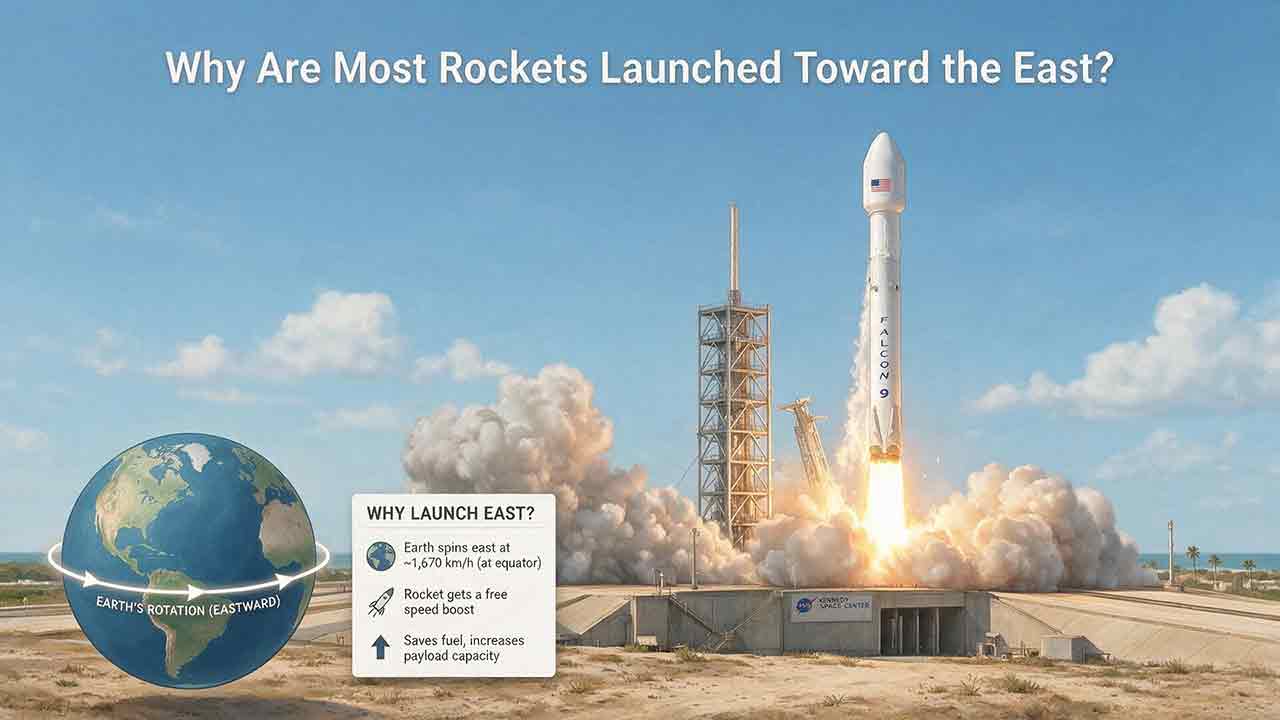
Why Are Most Rockets Launched Toward the East?
Most orbital rockets launch generally toward the east because Earth rotates from west to east, giving launch vehicles useful initial velocity before liftoff. This advantage is strongest near the equator and can reduce the additional speed a rocket must produce for compatible prograde orbits. However, launch direction is not determined by efficiency alone. Target orbital inclination, launch-site latitude, populated areas, stage-impact zones, range-safety rules, and mission objectives may require a rocket to travel northeast, southeast, south, or along a retrograde trajectory. This article explains how Earth’s rotation contributes to launch performance, compares Kourou with Cape Canaveral through a transparent calculation, and shows how latitude and launch azimuth affect the usable speed component. It also introduces the reader-friendly EAST framework for evaluating real missions and explains why polar, Sun-synchronous, and range-constrained launches often do not fly directly east.
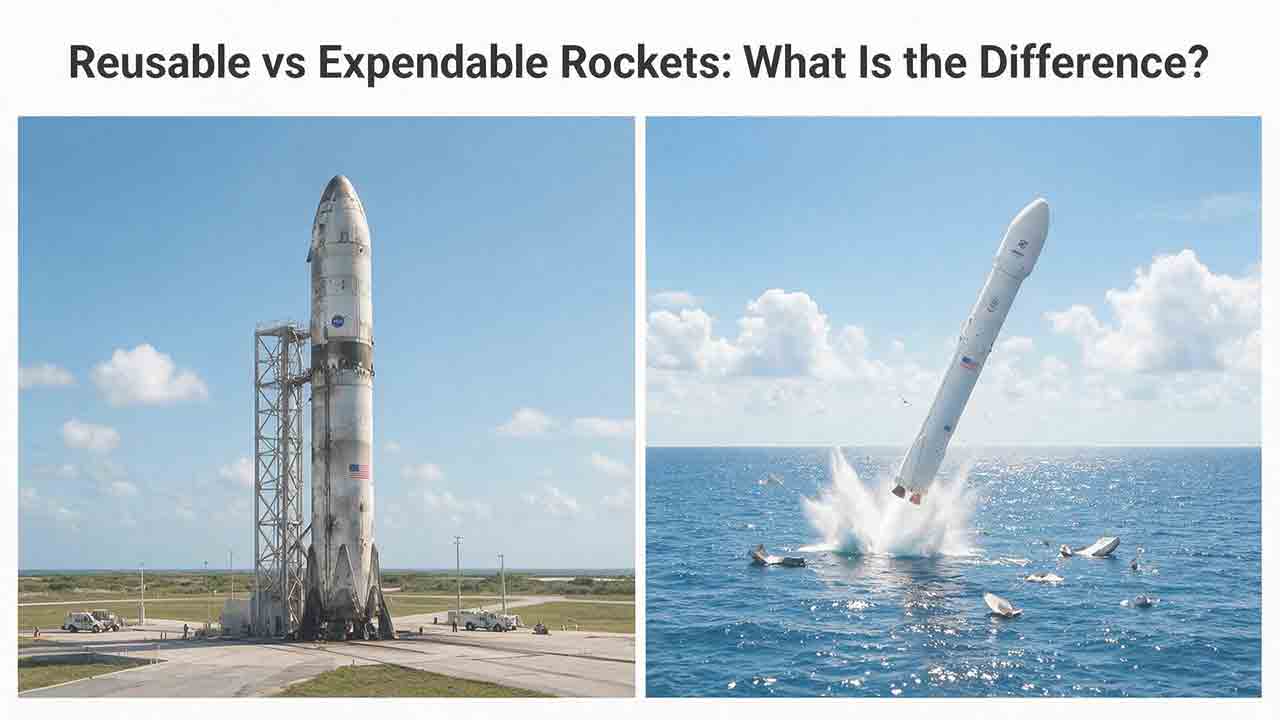
Reusable vs Expendable Rockets: What Is the Difference?
Reusable and expendable rockets follow two different approaches to launch vehicle design. Reusable systems recover and fly again one or more major components, while expendable rockets use each propulsive stage only once. This guide compares the two architectures across payload performance, recovery requirements, launch cadence, reliability, refurbishment, and mission cost. It explains why reusable rockets may reduce average hardware costs when stages fly frequently, while expendable configurations can preserve more performance for demanding payloads or high-energy destinations. The article also distinguishes partial reuse from full reuse, examines Falcon 9, NASA’s Space Launch System, and ESA’s Themis demonstrator, and introduces the original RAMP framework for early mission screening. A fictional cost-sensitivity example, decision tree, troubleshooting table, and practical checklist help readers evaluate launch options without relying on unsupported commercial cost claims or treating either architecture as universally superior.
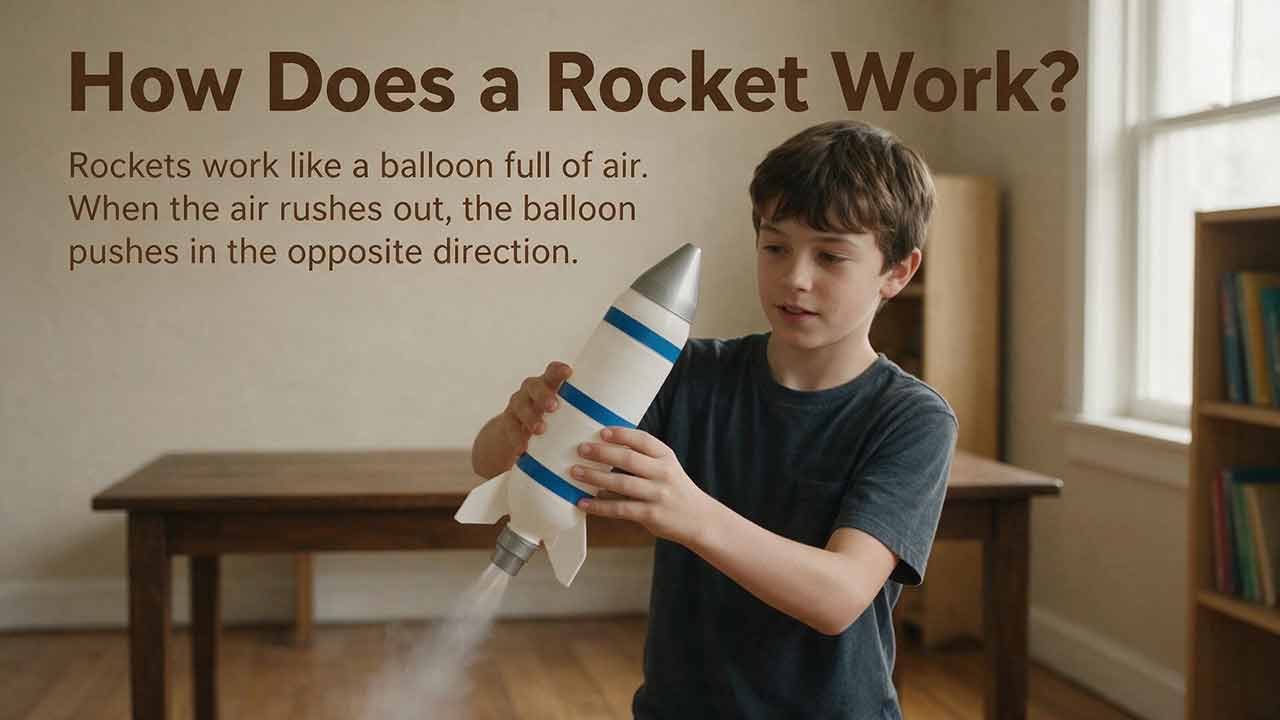
How Does a Rocket Work?
A rocket works by carrying propellant and accelerating exhaust backward at high speed, producing forward thrust through conservation of momentum. This article explains the complete process from engine ignition and liftoff to guidance, staging, orbit insertion, and payload separation. It shows why rockets carry both fuel and an oxidizer, how a nozzle converts pressure into exhaust velocity, why rocket engines can operate in a vacuum, and why reaching orbit requires substantial horizontal speed rather than altitude alone. Readers will also find transparent examples for calculating thrust-to-weight ratio and ideal delta-v, along with comparisons of liquid, solid, and hybrid propulsion systems. Practical tables explain Max Q, launch phases, steering methods, payload fairings, mission tradeoffs, and common launch-broadcast terminology. Based on authoritative NASA and European Space Agency references, the guide clearly separates established physics, simplified estimates, and original explanatory frameworks while avoiding construction, ignition, propellant, or operational launch instructions.
Explore More Topics
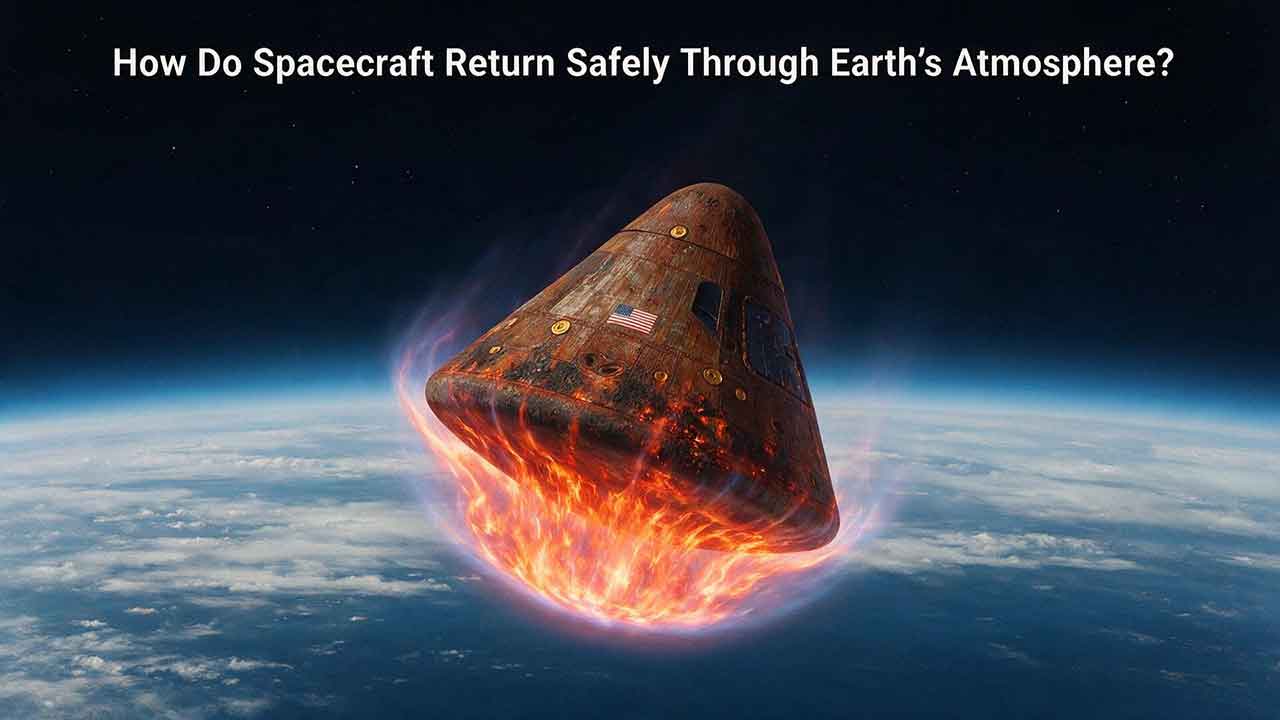
How Do Spacecraft Return Safely Through Earth’s Atmosphere?
Spacecraft return safely through Earth’s atmosphere by managing an enormous amount of energy through a carefully coordinated sequence of trajectory control, thermal protection, aerodynamic deceleration, landing, and recovery. This article explains how deorbit burns and entry corridors guide a spacecraft toward its landing region, why blunt heat shields reduce the danger of hypersonic heating, and how guidance systems control attitude, range, and structural loads. It includes an original comparison of low-Earth-orbit and lunar-return energy, a practical review of ablative and reusable heat-shield technologies, and the CosmoBasics Four-Layer Reentry Framework covering path, protection, control, descent, and recovery. Real-world lessons from Artemis I and the crewed Artemis II mission show why postflight inspection remains essential even after a successful splashdown. Readers will also learn how parachutes, wings, landing rockets, flotation systems, and recovery teams complete the return safely.

How Do Astronauts Sleep, Eat, and Exercise in Space?
Astronauts must redesign ordinary routines when they live in microgravity. This article explains how crew members sleep in secured bags inside ventilated quarters, prepare packaged meals without letting food or liquids drift through the cabin, and use specialized exercise equipment to protect their physical condition. It examines the roles of the Advanced Resistive Exercise Device, the T2 treadmill, and the CEVIS cycle ergometer, while clarifying the difference between active workout time and the full scheduled exercise period. Readers will also learn why tortillas are practical in space, how airflow affects sleep, why ordinary weights do not work normally in orbit, and how nutrition, rest, and exercise support one another. NASA and ESA sources provide the factual foundation, while original comparison tables and practical evaluation frameworks show how spacecraft systems replace functions normally supplied by gravity. The article also distinguishes current International Space Station practices from possible future Moon and Mars mission requirements.
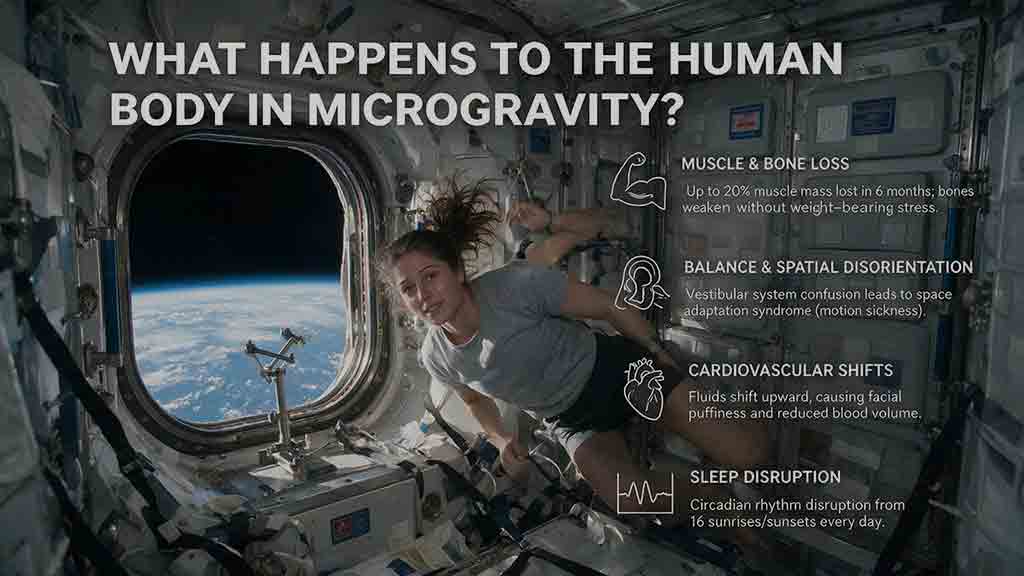
What Happens to the Human Body in Microgravity?
Microgravity changes the human body because fluids are no longer pulled toward the legs, muscles and bones receive less mechanical loading, and the brain loses gravity as a dependable orientation signal. This article explains how weightlessness affects balance, circulation, muscle strength, bone density, vision, blood, immunity, digestion, sleep, and spinal length. It also examines why astronauts may struggle to stand or walk after landing and how exercise, nutrition, monitoring, and rehabilitation help reduce these risks. Two original tools—the Load–Flow–Orientation Framework and the Gravity-Transition Readiness Matrix—connect physiological changes with real mission demands. Drawing on NASA standards, NASA technical reports, ESA materials, and peer-reviewed human spaceflight research, the guide clearly separates established observations from experimental countermeasures and unresolved questions. It also explains what these effects could mean for future missions to the Moon and Mars without treating population averages as predictions for individual astronauts.