How Do Astronauts Breathe in Space?

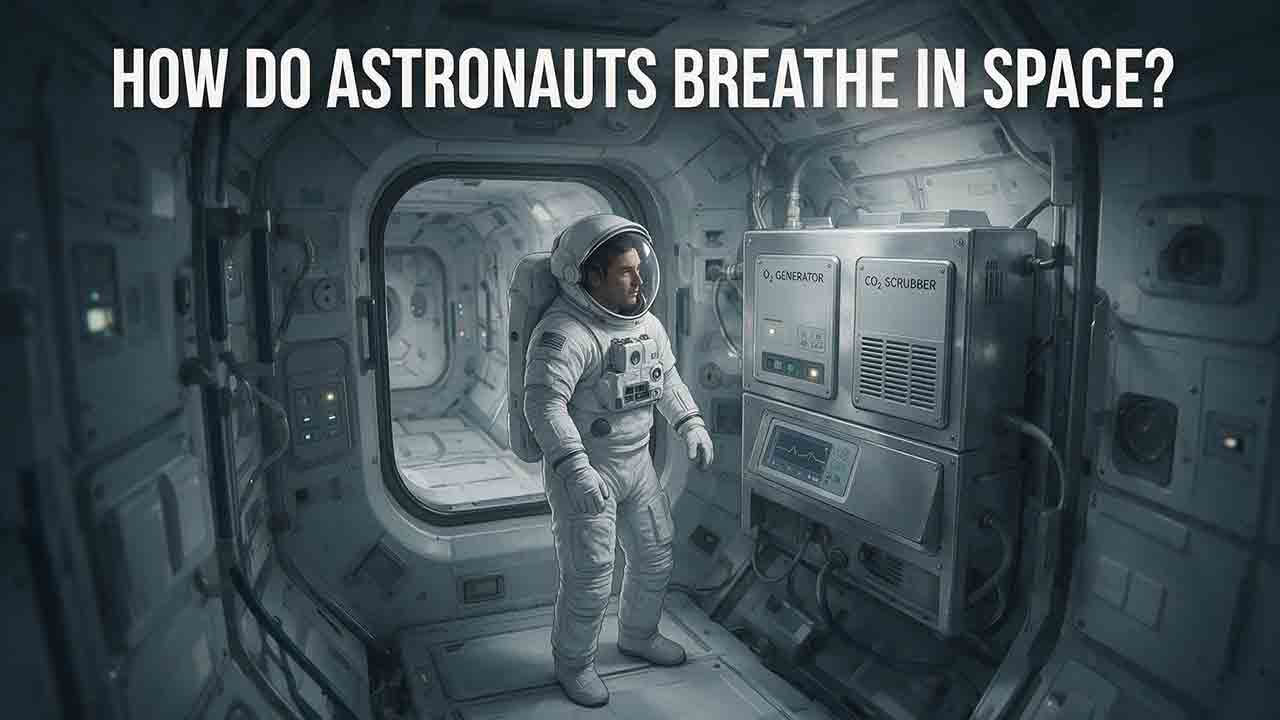
How Do Astronauts Breathe in Space?
Astronauts breathe inside sealed, pressurized spacecraft and spacesuits that recreate the atmospheric conditions human lungs need. Life-support systems replace consumed oxygen, circulate cabin gas with fans, remove exhaled carbon dioxide, control humidity and contaminants, and monitor pressure. On the International Space Station, much of the replacement oxygen is produced by splitting purified water.
Key Takeaways
- Astronauts do not breathe the vacuum of space; they breathe inside a pressurized cabin or spacesuit.
- Oxygen supply is only one part of the problem. Pressure, ventilation, carbon dioxide removal, humidity control, and monitoring must work together.
- The International Space Station produces replacement oxygen mainly through water electrolysis.
- Fans are essential because microgravity does not produce the same buoyancy-driven air circulation found on Earth.
- During a spacewalk, a portable life-support backpack performs many of the same functions as a spacecraft cabin for one astronaut.
The most useful way to understand astronaut breathing is to follow the entire atmospheric loop. Oxygen enters the breathing environment, the crew consumes part of it, carbon dioxide and moisture are produced, and machinery continuously cleans and reconditions the gas.
What Makes a Spacecraft Atmosphere Breathable?
A breathable spacecraft atmosphere requires more than a tank of oxygen.
For this guide, the essential functions can be organized into a four-part Pressure–Oxygen–Circulation–Cleanup framework. This is an original educational framework used to explain the system; it is not an official NASA term.
| Function | What the spacecraft controls | Why it matters |
|---|---|---|
| Pressure | The total pressure surrounding the crew | Human lungs cannot function normally in a vacuum |
| Oxygen | The oxygen available at an appropriate partial pressure | Human metabolism consumes oxygen continuously |
| Circulation | Movement of gas through occupied spaces and life-support equipment | Exhaled carbon dioxide must be moved away from the face |
| Cleanup | Removal of carbon dioxide, moisture, particles, and trace chemicals | A sealed atmosphere would otherwise become progressively less habitable |
NASA groups these and related functions within the Environmental Control and Life Support System, usually shortened to ECLSS. The International Space Station’s ECLSS includes water recovery, air revitalization, oxygen generation, atmospheric-pressure control, ventilation, fire protection, and waste management.
NASA’s Environmental Control and Life Support Systems overview describes the Water Recovery System, Air Revitalization System, and Oxygen Generation System as parts of one connected habitat architecture.
A spacecraft therefore does not carry a fixed volume of air and leave it unchanged. It continuously manages a changing atmosphere.
How Does the Spacecraft Breathing Loop Work?
The atmosphere inside a crewed spacecraft passes through a repeating process.
1. The pressure shell keeps gas inside
Space is effectively a vacuum compared with the interior of a spacecraft. The vehicle’s pressure shell, windows, hatches, seals, valves, and plumbing limit the loss of cabin gas.
Before the crew occupies the vehicle, gases are introduced until the cabin reaches its intended pressure and composition. Many mixed-gas spacecraft atmospheres use oxygen together with nitrogen, which primarily acts as a diluent and is not consumed by normal human metabolism.
Nitrogen is still physiologically important during pressure changes. It can dissolve in body tissues and contribute to decompression sickness when pressure is reduced too quickly.
Cabin nitrogen can also be lost through leakage, venting, airlock operations, docking activity, or maintenance.
2. Oxygen is replaced as the crew consumes it
Astronauts inhale oxygen and use part of it during cellular metabolism. The life-support system must replace the oxygen removed from the atmosphere in this way.
A spacecraft may obtain oxygen from several sources:
- Water electrolysis
- Stored compressed oxygen
- Chemical oxygen generators
- Gas supplied by a docked or resupply vehicle
- Partial recovery from exhaled carbon dioxide
On the ISS, electrolysis is the principal regenerative method used to produce replacement oxygen. Stored gas and other supply paths provide backup and operational flexibility.
3. Fans keep the atmosphere moving
On Earth, warmer air tends to rise and cooler air tends to sink because gravity drives buoyancy and natural convection. Microgravity greatly weakens that familiar mixing process.
Spacecraft therefore depend on forced ventilation. Fans and ducts:
- Move exhaled carbon dioxide away from an astronaut’s face
- Deliver cabin gas to occupied areas
- Carry gas through scrubbers and filters
- Distribute heat
- Move humidity toward recovery equipment
- Reduce poorly ventilated pockets
A 2025 NASA computational study modeled local oxygen depletion and carbon dioxide accumulation after ventilation was interrupted. The analysis showed why a reasonable cabin-average reading may not describe the gas immediately surrounding a crewmember’s nose and mouth.
The study is available through the NASA Technical Reports Server.
4. Sensors monitor atmospheric conditions
Crewed spacecraft use fixed and portable instruments to monitor conditions such as:
- Total cabin pressure
- Oxygen partial pressure
- Carbon dioxide partial pressure
- Nitrogen concentration
- Humidity
- Temperature
- Smoke and combustion products
- Selected trace contaminants
Measurements may be taken at multiple locations because large vehicles can develop local variations related to airflow, equipment placement, module geometry, and crew activity.
A single cabin-average measurement cannot always reveal a poorly ventilated pocket near a sleeping station, exercise area, or workstation.
5. Carbon dioxide is removed
Every breath adds carbon dioxide to the cabin. In a sealed vehicle, the concentration would continue to rise unless circulating gas passed through removal equipment.
Carbon dioxide scrubbers separate carbon dioxide from the atmosphere while allowing most oxygen and nitrogen to return to occupied spaces.
Depending on the system, captured carbon dioxide may be:
- Released outside the spacecraft
- Sent to a carbon dioxide reduction process
- Held temporarily
- Processed by experimental recovery equipment
Removing carbon dioxide is not the same as producing oxygen. A scrubber cleans the atmosphere, but additional processing is required to recover oxygen atoms from the captured carbon dioxide.
6. Humidity and contaminants are controlled
Astronauts add water vapor to the cabin through breathing, perspiration, exercise, hygiene, and food preparation.
Condensing heat exchangers remove excess humidity. Water separators collect the condensate, which can then enter the spacecraft’s water-recovery system.
Filters and adsorbent materials also help control:
- Dust and fibers
- Odors
- Material outgassing
- Volatile organic compounds
- Smoke particles
- Trace chemical releases
- Microbial contamination
Humidity control is connected to both breathing and temperature regulation. Condensation can damage equipment, promote microbial growth, obscure windows, and create uncomfortable local conditions.
This relationship is why cabin atmosphere control and thermal control are tightly coupled: removing moisture and carbon dioxide changes air conditions, while heat exchangers and coolant systems help keep temperature and humidity within acceptable ranges.
7. Water and oxygen return to the loop
Recovered humidity and wastewater can be purified. The resulting water may be used for drinking, hygiene, cooling, experiments, or oxygen generation.
The simplified breathing loop is:
Oxygen supply → crew metabolism → carbon dioxide and moisture → fan-driven circulation → carbon dioxide removal → humidity recovery → water purification → electrolysis → oxygen supply
The loop is regenerative, but it is not completely closed. Leakage, airlock operations, waste streams, incomplete oxygen recovery, maintenance, and equipment limitations create continuing resupply needs.
How Does the ISS Make Oxygen From Water?
The ISS produces replacement oxygen mainly through electrolysis, a process that uses electrical energy to split water into oxygen and hydrogen.
The simplified chemical reaction is:
2H₂O → 2H₂ + O₂
Oxygen produced by the system enters the cabin atmosphere. Hydrogen can be sent to carbon dioxide reduction equipment when the relevant system is operating.
NASA describes the Oxygen Generation Assembly as an electrolysis cell stack that receives processed water from the station’s water-recovery equipment. Oxygen generation is therefore connected directly to the station’s ability to reclaim and purify water.
How can exhaled carbon dioxide help recover oxygen?
Hydrogen from electrolysis can react with captured carbon dioxide through a Sabatier process:
CO₂ + 4H₂ → CH₄ + 2H₂O
The reaction produces methane and water. The water can be purified and split again through electrolysis, allowing some oxygen atoms from exhaled carbon dioxide to return to the cabin atmosphere.
The methane contains hydrogen that is not fully returned to the loop in the ISS architecture discussed here. That loss prevents complete oxygen recovery.
NASA reports an estimated average recovery of about 47% for the ISS Carbon Dioxide Reduction Assembly and commonly summarizes the existing Sabatier-based capability as recovering about 50% of the oxygen associated with metabolic carbon dioxide.
This does not mean half of all oxygen aboard the station is recycled. It refers specifically to the defined pathway that processes carbon dioxide produced by crew metabolism.
NASA explains the existing performance and future recovery goals on its SpaceCraft Oxygen Recovery project page.
What does ESA’s Advanced Closed Loop System do?
The European Space Agency’s Advanced Closed Loop System, or ACLS, was introduced as both a technology-demonstration and operational life-support system aboard the ISS.
ACLS:
- Concentrates carbon dioxide removed from cabin gas.
- Combines that carbon dioxide with hydrogen in a Sabatier reactor.
- Produces methane and water.
- Sends the recovered water to an electrolyser.
- Returns oxygen to the station atmosphere.
ESA states that ACLS can generate about 50% of the water needed for oxygen production on the Space Station.
That does not mean ACLS supplies half of all water used aboard the ISS. The percentage refers specifically to water associated with oxygen production in the described closed-loop process.
ESA provides a system overview on its Advanced Closed Loop System page.
How Much Oxygen Does an Astronaut Use?
Oxygen consumption varies with body size, health, diet, exercise, workload, and mission schedule. There is no single daily figure that applies to every astronaut under every condition.
For the worked example below, this article uses the standard mission day with exercise profile reproduced in NASA’s March 2026 carbon dioxide technical brief:
- 0.82 kg of oxygen consumed per crewmember-day
- 1.04 kg of carbon dioxide produced per crewmember-day
- A respiratory quotient of 0.92
NASA identifies the Human Integration Design Handbook as the underlying source for this profile. These are engineering planning values rather than universal biological constants.
The complete table and its assumptions are available in NASA OCHMO-TB-004 Revision D: Carbon Dioxide.
Worked example: four astronauts for 30 days
Assume:
- 4 astronauts
- 30 mission days
- 0.82 kg of oxygen consumed per astronaut per day
- 1.04 kg of carbon dioxide produced per astronaut per day
First calculate the number of crewmember-days:
4 × 30 = 120 crewmember-days
Estimated metabolic oxygen consumption:
120 × 0.82 kg = 98.4 kg of oxygen
Estimated carbon dioxide production:
120 × 1.04 kg = 124.8 kg of carbon dioxide
Water contains approximately 88.9% oxygen by mass. Two water molecules have a combined molecular mass of approximately 36 units, of which 32 units come from oxygen.
The ideal water mass containing 98.4 kilograms of oxygen is:
98.4 × 36 ÷ 32 = 110.7 kg of water
| Calculated quantity | Simplified result |
|---|---|
| Total crewmember-days | 120 |
| Estimated oxygen consumed | 98.4 kg |
| Estimated carbon dioxide produced | 124.8 kg |
| Ideal water containing 98.4 kg of oxygen | 110.7 kg |
What does the calculation actually mean?
The 98.4-kilogram result represents oxygen consumed under the selected NASA mission-day profile.
The 110.7-kilogram result is the ideal stoichiometric mass of water containing that oxygen. It does not mean the mission must launch exactly 110.7 kilograms of additional water.
A real mission analysis would also include:
- Water already circulating through the vehicle
- Recovered humidity and wastewater
- Oxygen recovered from carbon dioxide
- Electrolysis performance
- Cabin leakage
- Airlock losses
- Spacesuit operations
- Equipment downtime
- Stored reserves
- Variations in crew activity
- Contingency margins
The calculation shows why regenerative life support becomes more valuable as crew size and mission duration increase. It is not an operational supply manifest.
What Kind of Air Do Astronauts Breathe on the ISS?
The ISS normally uses a mixed-gas atmosphere designed around sea-level-type conditions rather than a cabin filled with pure oxygen.
NASA’s Habitable Atmosphere technical brief uses the following standard sea-level reference values:
- 14.7 psia, or 101.3 kPa, total pressure
- 20.95% oxygen
- 78.08% nitrogen
- Smaller quantities of argon, carbon dioxide, and other gases
Actual monitored values can vary within approved operating limits. The reference figures should not be interpreted as a claim that every location aboard the ISS remains at exactly those values at every moment.
The technical background is available in NASA OCHMO-TB-003: Habitable Atmosphere.
Why does oxygen partial pressure matter?
Oxygen percentage alone does not determine whether an atmosphere is breathable. Total pressure also matters.
A simplified relationship is:
Oxygen partial pressure = total pressure × oxygen fraction
Using the sea-level reference:
14.7 psi × 0.2095 ≈ 3.08 psi
This helps explain how a lower-pressure spacesuit can still provide sufficient oxygen when it uses a much higher oxygen concentration.
Atmosphere design must also consider:
- Material flammability
- Fire propagation
- Oxygen toxicity
- Decompression sickness
- Structural mass
- Heat transfer
- Suit mobility
- Emergency pressure changes
A higher oxygen percentage is therefore not automatically safer.
Why Is Carbon Dioxide Removal as Important as Oxygen Supply?
A spacecraft can contain enough oxygen while becoming unsafe because carbon dioxide is accumulating.
Carbon dioxide is produced continuously by human metabolism. Exercise and physically demanding work increase the production rate. Without active removal, its concentration rises over time.
NASA’s March 2026 carbon dioxide technical brief discusses atmospheric monitoring, localized carbon dioxide pockets, vehicle scrubbers, spacesuit washout, and human-exposure considerations. It also explains that carbon dioxide levels can vary between locations because ventilation and scrubber placement are not identical throughout a large spacecraft.
The central principle is simple:
A spacecraft atmosphere is not breathable merely because it contains oxygen. Exhaled gas must also be moved away from the crew and removed continuously.
How Do Carbon Dioxide Scrubbers Work?
Many spacecraft scrubbers use materials that adsorb carbon dioxide molecules onto their surfaces.
Adsorption means molecules collect on a material’s surface. It is different from absorption, in which a substance enters the volume of another material.
The ISS Carbon Dioxide Removal Assembly uses a regenerable four-bed molecular-sieve process:
- Cabin gas enters a desiccant section that removes moisture.
- The dry gas passes through a zeolite adsorbent that captures carbon dioxide.
- Scrubbed gas returns to the cabin.
- Another bed is isolated for regeneration.
- Heating and exposure to vacuum release the captured carbon dioxide.
- The beds switch roles so removal can continue.
NASA describes this alternating-bed architecture in OCHMO-TB-004 Revision D.
The technical brief states that the Carbon Dioxide Removal Assembly can continuously remove a six-person-equivalent carbon dioxide load when both removal beds are operating. “Person-equivalent” is an engineering load term; it does not mean every group of six people produces exactly the same carbon dioxide load under every activity profile.
Earlier and shorter-duration spacecraft have also used replaceable lithium hydroxide cartridges.
| Scrubber approach | Main advantage | Main limitation |
|---|---|---|
| Lithium hydroxide cartridge | Mechanically simple and effective for limited use | Finite capacity; used material becomes waste |
| Regenerative molecular sieve | Reusable and suitable for longer missions | Requires valves, heaters, seals, power, and maintenance |
Regeneration reduces consumable mass, but it does not eliminate equipment failures, maintenance, or replacement-part requirements.
How Do Astronauts Breathe During a Spacewalk?
During a spacewalk, an astronaut breathes inside a pressurized spacesuit supplied by a Portable Life Support System, or PLSS.
The PLSS backpack performs many functions normally handled by the spacecraft cabin:
- Supplies oxygen
- Regulates pressure
- Circulates breathing gas
- Removes carbon dioxide
- Controls humidity
- Supports cooling
- Supplies electrical power
- Monitors suit conditions
- Supports communication systems
Why does the ISS spacesuit use lower pressure?
A pressurized suit resists bending because the internal gas pushes outward against its structure. Lower pressure can improve mobility, provided the atmosphere still supplies an adequate oxygen partial pressure.
NASA’s 2019 Extravehicular Mobility Unit fact sheet states that the Shuttle and ISS EMU configurations described in the document operate at 4.3 psia, or 29.6 kPa.
The fact sheet is available from NASA as Extravehicular Mobility Unit.
The 4.3-psia value applies to those documented EMU configurations. It is not a universal pressure for every historical, present, or future spacesuit.
Why do astronauts prebreathe oxygen?
The ISS cabin contains nitrogen, while the lower-pressure EMU atmosphere is oxygen-rich.
Before entering the suit environment, astronauts follow a mission-approved prebreathe procedure that reduces the amount of dissolved nitrogen in the body. This lowers the risk of nitrogen bubbles forming as pressure decreases and causing decompression sickness.
The required procedure depends on:
- Cabin pressure
- Suit pressure
- Atmospheric composition
- Workload
- Mission design
- Medical requirements
Prebreathing is a controlled spaceflight procedure carried out under approved operational and medical protocols. It is not a general public technique.
For more about suit pressure, cooling, mobility, and environmental protection, see How Do Spacesuits Keep Astronauts Alive?.
How Are Cabin and Suit Breathing Systems Different?
| Environment | Breathing source | Pressure approach | Carbon dioxide control | Main purpose |
|---|---|---|---|---|
| Spacecraft cabin | Generated oxygen, stored gas, and recycled resources | Mixed-gas atmosphere selected for the vehicle | Central air-revitalization equipment | Support several people for hours, days, or months |
| ISS EMU | Oxygen and circulation provided by the PLSS | Lower-pressure, oxygen-rich atmosphere | Portable cartridge or scrubber | Support one astronaut during a spacewalk |
| Launch and entry suit | Vehicle-fed gas with suit contingency capability | Integrated with launch and emergency design | Vehicle or suit ventilation | Protect the crew during launch, landing, or depressurization |
| Emergency breathing equipment | Stored oxygen or filtered cabin gas | Short-duration contingency configuration | Equipment-specific | Provide temporary protection during smoke or contamination |
A launch and entry suit is not automatically suitable for a spacewalk. A spacewalk suit requires independent pressure, cooling, carbon dioxide removal, power, communications, mobility, and protection from the external environment.
Do Astronauts Carry Oxygen Tanks Inside the ISS?
No. Astronauts normally breathe the station’s shared cabin atmosphere without wearing helmets, masks, or personal oxygen tanks.
Personal breathing equipment becomes important during:
- Spacewalks
- Launch and landing
- Cabin depressurization
- Smoke or contamination events
- Medical contingencies
- Certain maintenance activities
During ordinary station life, centralized life-support equipment serves the entire crew.
What Happens If Oxygen Generation Stops?
An oxygen-generator outage does not make a pressurized cabin instantly unbreathable.
The cabin already contains an oxygen inventory. The vehicle may also have stored oxygen, alternate generation equipment, docked-vehicle resources, repair options, and mission reserves.
A useful way to evaluate the problem is the Inventory–Rate–Recovery framework, another original educational tool used in this guide.
Inventory
How much usable oxygen is already present in the cabin and storage systems?
Rate
How quickly is oxygen being consumed or lost?
The rate depends on crew size, activity, leakage, airlock use, and other mission factors.
Recovery
What backup, repair, resupply, docking, safe-haven, or mission-shortening options are available?
This framework distinguishes an oxygen-production failure from a pressure leak. Metabolic oxygen consumption normally changes cabin conditions gradually. A major leak can remove oxygen, nitrogen, and total pressure much more rapidly.
No universal claim such as “the crew has exactly a certain number of hours” is reliable without knowing the vehicle volume, crew size, activity level, oxygen inventory, leak rate, and backup capability.
For a broader explanation of leakage and decompression, see What Happens If a Spacecraft Loses Pressure?.
What Happens If Carbon Dioxide Removal Stops?
Carbon dioxide may become the limiting atmospheric resource even while enough oxygen remains.
How quickly conditions change depends on:
- Crew size
- Activity level
- Cabin volume
- Starting carbon dioxide concentration
- Ventilation
- Remaining scrubber capacity
- Alternate removal equipment
- Outage duration
Ventilation and scrubbing capacity must be considered together. A functioning scrubber cannot effectively clean gas that is not reaching it.
Human-rated spacecraft use alarms, independent measurements, redundant equipment, maintenance capability, consumable backups, and mission-control analysis. Actual responses depend on approved vehicle-specific procedures.
How Are Breathing-System Problems Interpreted?
The following table explains system relationships. It is not an emergency checklist.
| Observed condition | Possible system causes | System-level questions |
|---|---|---|
| Oxygen trends downward | Normal metabolic use, generator outage, leakage, sensor error, or supply problem | Do independent sensors agree? Is total pressure changing? What backup inventory exists? |
| Carbon dioxide trends upward | Scrubber degradation, valve malfunction, reduced airflow, maintenance outage, or higher crew load | Is the problem local or cabin-wide? Is alternate capacity available? |
| One area feels poorly ventilated | Blocked duct, fan fault, poor mixing, or local metabolic load | Do readings differ between occupied locations? |
| Humidity rises | Heat-exchanger, separator, cooling, or water-processing problem | Is condensation forming? Is moisture-removal performance declining? |
| Cabin pressure falls | Leakage, valve position, seal problem, planned venting, or sensor fault | What is the pressure-loss rate? Can the affected volume be isolated? |
| Sensors disagree | Calibration drift, sample-line issue, electrical fault, or a real atmospheric gradient | What do independent instruments and other sampling points show? |
| Odor or irritation is reported | Outgassing, overheated equipment, smoke, chemical release, or filtration problem | Can the source be identified and atmospheric samples compared? |
These are educational questions, not instructions for responding to an actual spacecraft emergency.
Which Oxygen-Supply Method Is Best?
No single oxygen system is best for every mission.
| Oxygen approach | Advantages | Limitations | Most suitable use |
|---|---|---|---|
| Stored compressed oxygen | Available without water processing; useful as backup | Storage mass rises with mission duration | Short missions, spacesuits, reserves, and contingencies |
| Water electrolysis | Uses water already required by the crew | Requires electricity, purified water, separation hardware, and maintenance | Stations and long-duration habitats |
| Carbon dioxide reduction | Returns some exhaled oxygen to the loop through recovered water | Adds reactors, heat, plumbing, and maintenance; recovery remains incomplete | Longer missions where resupply reduction justifies complexity |
| Chemical oxygen generation | Compact and independent of electrolysis | Consumable and heat-producing | Specialized backup applications |
| Biological production | Could eventually integrate oxygen, food, waste, and water processing | Slow response, biological variability, lighting demand, and crop-failure risk | Research and future closed-loop habitats |
A practical decision rule
Stored supplies become heavier as crewmember-days accumulate. Regenerative equipment has an initial hardware cost but can process resources repeatedly.
A short mission may favor stored consumables because simplicity and low maintenance have value. A long mission may justify regeneration because repeatedly launching oxygen and water becomes increasingly expensive.
The decision must balance:
- Consumable mass
- Hardware mass
- Electrical power
- Cooling demand
- Maintenance time
- Spare parts
- Reliability
- Repairability
- Waste production
- Backup capability
The best system is not automatically the one with the highest recycling percentage. It is the architecture that meets crew-safety and mission requirements with acceptable mass, power, maintenance, and failure tolerance.
Do Plants Supply Oxygen on the ISS?
No. The ISS does not depend on plants as its primary oxygen source.
Plants are grown in space for research into crop health, biology, food production, and future exploration systems. The station’s crew relies on mechanical and chemical systems for oxygen generation, ventilation, carbon dioxide removal, and atmospheric monitoring.
Biological life support may become more important on longer missions, but living systems introduce additional constraints:
- Growth cycles
- Lighting and power demand
- Water and nutrient requirements
- Crop disease or failure
- Microbial control
- Waste processing
- Variable oxygen production
- Mismatches between plant output and crew demand
ESA’s MELiSSA program studies how biological and physical processes might convert organic waste, carbon dioxide, and minerals into food, oxygen, and water.
MELiSSA remains a research program rather than the ISS crew’s primary oxygen source. ESA explains the concept on its MELiSSA Closed Loop Concept page.
Does the ISS Really Recover 98% of Its Water?
NASA uses more than one public figure when describing ISS water recovery.
NASA’s general ECLSS overview uses a broad description of recovering and recycling about 90% of station water resources.
A separate NASA milestone report states that:
- Overall recovery was approximately 93%–94% before the Brine Processor Assembly was included.
- Recent assessments demonstrated that the evaluated system could reach a 98% total water-recovery goal with the Brine Processor Assembly.
NASA documents this result in NASA Achieves Water Recovery Milestone on International Space Station.
The cited pages do not establish that every difference between the public figures has one simple cause. They represent a broad overview and a more specific demonstrated system milestone.
The safest interpretation is:
- “About 90%” is a broad figure used in NASA’s general ECLSS overview.
- “93%–94%” describes overall recovery before the Brine Processor contribution in the milestone report.
- “98%” is a demonstrated total-recovery milestone for the assessed system configuration.
- None of these figures should be treated as a guaranteed rate for every water stream, station segment, or operating condition.
Water recovery supports breathing because purified water can be routed to the oxygen-generation system.
Related reading includes How Does the International Space Station Recycle Water? and How Do Astronauts Get Water in Space?.
“Astronauts breathe from tanks like scuba divers”
That is partly true during suited operations, but not during everyday life inside a spacecraft. Astronauts aboard the ISS normally breathe a shared cabin atmosphere maintained by centralized equipment.
“Producing oxygen solves the entire problem”
Oxygen generation cannot replace pressure control, ventilation, carbon dioxide removal, humidity management, filtration, or atmospheric monitoring.
“Carbon dioxide scrubbers directly turn carbon dioxide into oxygen”
A scrubber normally separates carbon dioxide from cabin gas. Recovering oxygen requires additional carbon dioxide reduction and water electrolysis.
“The ISS recycles all its air and water”
The station recovers a large fraction of its resources, but its loops are not completely closed. Leakage, airlock losses, methane and other waste streams, incomplete oxygen recovery, and maintenance create continuing resupply needs.
“Pure oxygen is always safer”
A high oxygen fraction can support breathing at lower total pressure, but it also affects material flammability and fire behavior. Safe atmosphere design considers total pressure, oxygen partial pressure, exposure duration, materials, and mission operations together.
“Humans cannot breathe normally in microgravity”
The muscles used for breathing still function. The larger engineering challenge is moving exhaled gas away from the face without relying on Earth-like natural convection.
How Will Breathing Systems Change for Moon and Mars Missions?
Missions beyond low Earth orbit will have fewer opportunities for rapid resupply, replacement hardware, or emergency return.
Future life-support development therefore emphasizes:
- Recovering more oxygen from metabolic carbon dioxide
- Reducing water loss
- Extending component life
- Reducing maintenance workload
- Lowering power and cooling demand
- Improving repairability
- Reducing dependence on single-use consumables
- Managing lunar or Martian dust
- Integrating atmosphere, water, waste, and food systems
- Providing backup capability without excessive mass
NASA’s SpaceCraft Oxygen Recovery project is developing technologies intended to increase oxygen recovery to more than 75%, with a stretch goal of 100%.
Those percentages are development goals, not performance claims for the existing ISS system.
The ISS remains valuable as a test environment because long operation reveals maintenance demands, valve wear, seal problems, adsorbent degradation, contamination, sensor drift, and interactions that shorter ground tests may not expose.
How Can You Evaluate Any Space Habitat’s Breathing System?
When comparing a capsule, station, lunar habitat, or Mars vehicle, ask four questions.
1. How is pressure maintained?
Look for the intended cabin pressure, gas composition, leak-control strategy, compartment isolation, airlock losses, and emergency pressurization capability.
2. Where does replacement oxygen come from?
Determine whether the mission relies on stored gas, electrolysis, carbon dioxide recovery, resupply, chemical generation, biological processes, or a combination.
3. How is exhaled carbon dioxide removed?
Identify the scrubber technology, crew capacity, regeneration method, maintenance burden, backup capability, and dependence on airflow.
4. How long can the system operate without Earth?
Consider consumables, leakage, water recovery, electrical power, cooling, filters, adsorbents, spare parts, repair tools, maintenance time, and safe-haven options.
These questions provide a more useful assessment than asking only how many oxygen tanks a spacecraft carries.
The Practical Answer
Astronauts breathe in space because spacecraft recreate the pressure, oxygen supply, airflow, and atmospheric cleanup that Earth normally provides.
A pressure shell contains the gas. Oxygen generation or storage replaces oxygen consumed by the crew. Fans circulate the atmosphere, scrubbers remove carbon dioxide, heat exchangers collect humidity, and sensors track conditions.
On the ISS, purified water is split to produce oxygen, while some exhaled carbon dioxide is processed into reusable water. During a spacewalk, the same basic functions are compressed into a suit and portable life-support backpack.
Can astronauts breathe in space without a helmet?
Astronauts can breathe without a helmet inside a sealed and properly pressurized spacecraft. Outside the spacecraft, or inside a depressurized compartment, they need a pressure suit or another protected breathing environment.
Is the International Space Station filled with pure oxygen?
No. The ISS uses an Earth-like mixed-gas atmosphere rather than a pure-oxygen cabin. The ISS EMU uses a different lower-pressure, oxygen-rich atmosphere during spacewalks.
Why are fans necessary when the cabin already contains oxygen?
Fans move exhaled carbon dioxide away from an astronaut’s face and carry cabin gas through scrubbers, filters, and heat exchangers. Microgravity does not provide the same natural convection found on Earth.
How long could astronauts breathe if oxygen generation stopped?
There is no universal answer. It depends on cabin oxygen inventory, crew size, activity, leakage, stored reserves, alternate systems, docked vehicles, and repair or mission options. An oxygen-generation outage is not normally an instantaneous loss of breathable air.
Where does exhaled carbon dioxide go?
Scrubbers remove carbon dioxide from circulating cabin or suit gas. Some may be released outside the spacecraft, while some can be combined with hydrogen to produce water that can be purified and used again.
Evidence and Editorial Method
This is a source-based educational article using public NASA and European Space Agency material. It does not claim private mission access, hands-on spacecraft testing, or independent expert review.
The Pressure–Oxygen–Circulation–Cleanup and Inventory–Rate–Recovery frameworks are original educational structures created for this article. They are not NASA terminology.
The worked example uses the standard mission-day values reproduced in NASA’s March 2026 OCHMO-TB-004 Revision D. NASA states that this technical brief is reference material and does not supersede formal Agency, program, or contract requirements.
As of the July 31, 2026 fact check, NASA’s official standards listing identifies NASA-STD-3001 Volume 2 Revision F, dated July 14, 2026, as the active public version. Because the March 2026 technical brief predates Revision F, it is used here for its published explanatory tables and system descriptions rather than as a substitute for the later formal standard.
This article explains general life-support principles. It does not provide procedures for building or modifying oxygen and pressure hardware, selecting operational gas mixtures, performing spacesuit prebreathe protocols, or responding to an actual spacecraft emergency.
Core Atmosphere and Life-Support Sources
NASA. Environmental Control and Life Support Systems. Updated April 4, 2025.
NASA Office of the Chief Health and Medical Officer. OCHMO-TB-003: Habitable Atmosphere, Revision A. November 30, 2023.
NASA Office of the Chief Health and Medical Officer. OCHMO-TB-004: Carbon Dioxide, Revision D. March 10, 2026.
NASA. NASA-STD-3001 Volume 2 Revision F: Human Factors, Habitability, and Environmental Health. July 14, 2026.
ISS Systems and Spacesuit Sources
NASA Johnson Space Center. Extravehicular Mobility Unit. Fact Sheet FS-2019-07-JSC-EA010, 2019.
NASA. NASA Achieves Water Recovery Milestone on International Space Station. Originally published June 20, 2023.
European Space Agency. Advanced Closed Loop System.
Future Technology and Research Sources
NASA. SpaceCraft Oxygen Recovery.
European Space Agency. MELiSSA Closed Loop Concept.
NASA Technical Reports Server. Using CFD to Predict Inspired CO₂ and O₂ After Ventilation Shutoff. 2025.
More from Human Spaceflight
How Do Spacecraft Return Safely Through Earth’s Atmosphere?
Spacecraft return safely through Earth’s atmosphere by managing an enormous amount of energy through a carefully coordinated sequence of trajectory control, thermal protection, aerodynamic deceleration, landing, and recovery. This article explains how deorbit burns and entry corridors guide a spacecraft toward its landing region, why blunt heat shields reduce the danger of hypersonic heating, and how guidance systems control attitude, range, and structural loads. It includes an original comparison of low-Earth-orbit and lunar-return energy, a practical review of ablative and reusable heat-shield technologies, and the CosmoBasics Four-Layer Reentry Framework covering path, protection, control, descent, and recovery. Real-world lessons from Artemis I and the crewed Artemis II mission show why postflight inspection remains essential even after a successful splashdown. Readers will also learn how parachutes, wings, landing rockets, flotation systems, and recovery teams complete the return safely.
How Do Astronauts Sleep, Eat, and Exercise in Space?
Astronauts must redesign ordinary routines when they live in microgravity. This article explains how crew members sleep in secured bags inside ventilated quarters, prepare packaged meals without letting food or liquids drift through the cabin, and use specialized exercise equipment to protect their physical condition. It examines the roles of the Advanced Resistive Exercise Device, the T2 treadmill, and the CEVIS cycle ergometer, while clarifying the difference between active workout time and the full scheduled exercise period. Readers will also learn why tortillas are practical in space, how airflow affects sleep, why ordinary weights do not work normally in orbit, and how nutrition, rest, and exercise support one another. NASA and ESA sources provide the factual foundation, while original comparison tables and practical evaluation frameworks show how spacecraft systems replace functions normally supplied by gravity. The article also distinguishes current International Space Station practices from possible future Moon and Mars mission requirements.
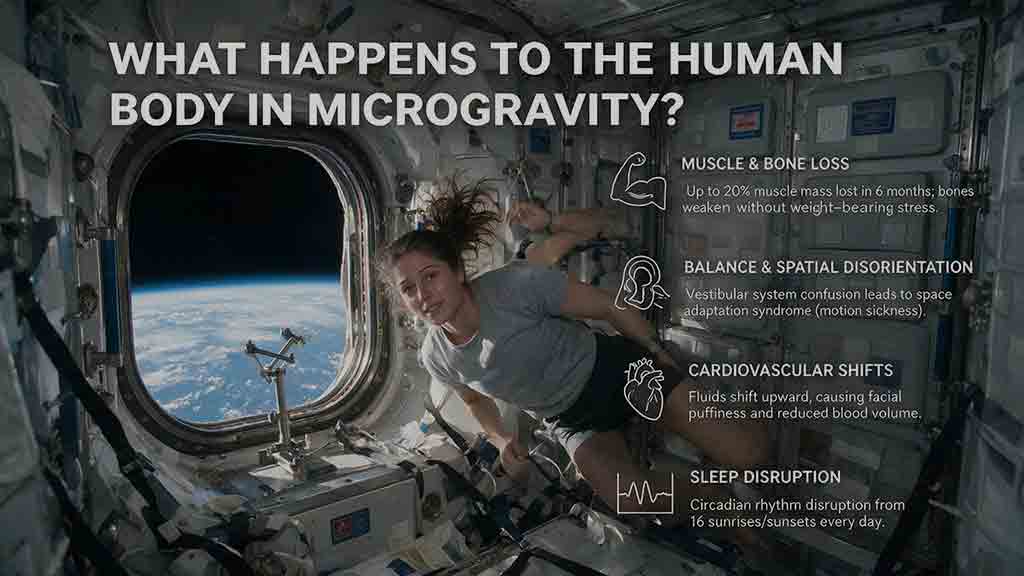
What Happens to the Human Body in Microgravity?
Microgravity changes the human body because fluids are no longer pulled toward the legs, muscles and bones receive less mechanical loading, and the brain loses gravity as a dependable orientation signal. This article explains how weightlessness affects balance, circulation, muscle strength, bone density, vision, blood, immunity, digestion, sleep, and spinal length. It also examines why astronauts may struggle to stand or walk after landing and how exercise, nutrition, monitoring, and rehabilitation help reduce these risks. Two original tools—the Load–Flow–Orientation Framework and the Gravity-Transition Readiness Matrix—connect physiological changes with real mission demands. Drawing on NASA standards, NASA technical reports, ESA materials, and peer-reviewed human spaceflight research, the guide clearly separates established observations from experimental countermeasures and unresolved questions. It also explains what these effects could mean for future missions to the Moon and Mars without treating population averages as predictions for individual astronauts.
Explore More Topics
How Are Space Missions Planned From Design to Launch?
Space missions are planned by transforming a scientific, commercial, or exploration goal into a complete system that can be designed, built, tested, launched, operated, and responsibly concluded. This guide follows the full planning lifecycle, from defining measurable objectives and comparing mission concepts to writing requirements, selecting an architecture, managing resource budgets, and controlling interfaces. It explains how payloads, spacecraft platforms, trajectories, launch services, software, ground systems, regulations, and operations must be developed together. Readers will also learn how design reviews, fabrication, environmental testing, end-to-end verification, operator training, licensing, launch integration, and readiness assessments support mission development. Original planning frameworks, worked mass, power, and data calculations, troubleshooting guidance, and a practical checklist show how teams identify weak assumptions and resolve designs that do not close. The central lesson is that mission readiness depends on the entire technical and operational system—not merely on completing the spacecraft.
What Happens During a Rocket Launch Countdown?
A rocket launch countdown is far more than a clock running toward zero. It is a carefully coordinated process that brings the launch vehicle, spacecraft, ground equipment, flight teams, weather conditions, and safety range into an approved configuration for liftoff. This article explains the major countdown phases, including launch-pad preparation, propellant loading, avionics and navigation checks, weather monitoring, range clearance, go/no-go polls, and terminal count. It also clarifies commonly misunderstood terms such as T-minus, L-minus, planned hold, recycle, scrub, and launch window. An original Four-C Countdown Framework—Clock, Configuration, Constraint, and Commitment—helps readers understand why teams may continue, pause, return to an earlier step, or cancel a launch attempt. Practical timelines, comparison tables, a launch-window calculation, and a viewer’s checklist make the article useful for students, educators, first-time launch viewers, and spaceflight enthusiasts.
How Do Spacecraft Dock in Orbit?
Spacecraft docking is a carefully controlled process that begins long before two vehicles make physical contact. The approaching spacecraft must first establish compatible orbital geometry, adjust its timing through phasing maneuvers, and reduce differences in position, velocity, and orientation. This guide explains the complete sequence from far-field rendezvous and relative navigation to hold points, final approach, soft capture, and hard capture. It also compares docking with robotic berthing, examines the sensors and control systems used during an approach, and shows how mission teams respond when navigation data, closing rates, or alignment fall outside permitted limits. A simplified orbital calculation demonstrates why a spacecraft in a slightly lower orbit can gradually catch its target. Readers will also find an original five-match framework, a practical docking-safety model, real mission examples, and a checklist for evaluating docking plans. The article clearly distinguishes educational principles from vehicle-specific flight procedures and engineering requirements.