How Does Mission Control Operate a Spacecraft?

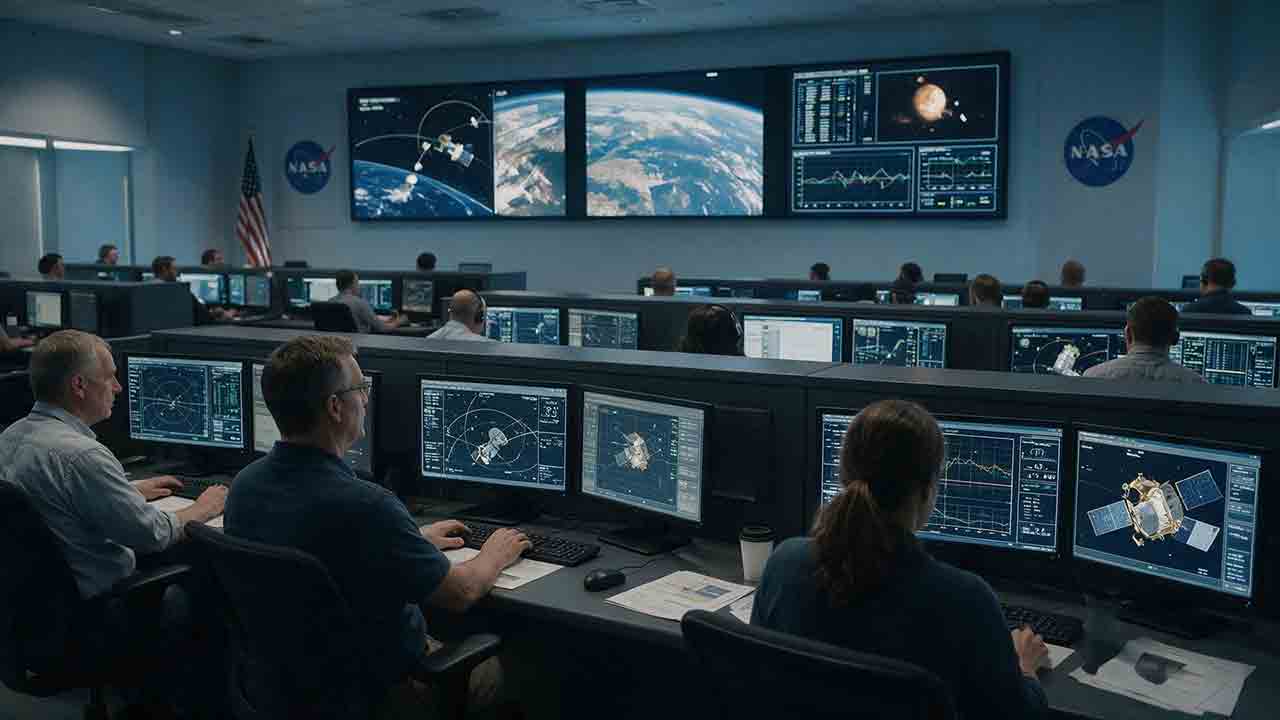
How Does Mission Control Operate a Spacecraft?
Mission control operates a spacecraft by planning activities, monitoring telemetry and tracking data, approving commands, transmitting them through ground networks, and verifying the result. Controllers rarely steer a spacecraft continuously. Ground teams manage the wider mission, while onboard computers—and astronauts on crewed missions—handle actions that must occur faster than Earth can respond.
Key Takeaways
- Mission control is a coordinated decision system, not simply a room where commands are transmitted.
- Telemetry reports spacecraft health and activity, while tracking data helps determine position and motion.
- Commands normally pass through planning, review, authorization, transmission, onboard validation, execution, and verification.
- Communication delay determines which decisions can remain on Earth and which must be handled locally.
- During an anomaly, preserving power, thermal safety, attitude, and communication usually takes priority over routine operations or science.
This guide explains how mission-control teams plan spacecraft activities, interpret incoming data, send verified commands, divide responsibility between Earth and the spacecraft, and respond when the mission does not proceed as expected.
How Does Mission Control Operate a Spacecraft From Earth?
Mission control uses a repeating operational loop:
- Define what the mission should accomplish.
- Predict the spacecraft state required to accomplish it safely.
- Observe the actual spacecraft through telemetry and tracking.
- Compare the observed condition with the prediction.
- Decide whether to continue, modify, postpone, or stop an activity.
- Send approved commands when ground action is required.
- Confirm the result before updating the next plan.
NASA describes human-spaceflight operations as including mission planning, testing, training, command and control, communications, trajectory support, simulations, and contingency preparation. Robotic missions use comparable functions, although their organizations, schedules, tools, and job titles differ.
NASA’s Advanced Multi-Mission Operations System provides software capabilities for spacecraft commanding, telemetry processing, mission planning, navigation, and data analysis across robotic missions.
Mission control therefore does more than issue instructions. It maintains the best evidence-based understanding of the spacecraft’s condition and uses that understanding to balance safety, mission objectives, and limited resources.
What Can Mission Control Actually Control?
Mission control can influence only functions that the spacecraft was designed to accept as ground commands.
Depending on the mission, controllers may be able to command:
- Spacecraft orientation
- Thruster or engine maneuvers
- Solar-array positioning
- Battery-charging configurations
- Heater settings
- Communication modes
- Scientific instrument activities
- Data recording and transmission
- Software configuration changes
- Rendezvous or docking preparations
- Entry, descent, or landing sequences
- Recovery from a protective operating mode
Mission control cannot create a capability the spacecraft does not possess. Every action is constrained by hardware, software, electrical power, thermal limits, propellant, antenna geometry, data storage, communication coverage, and the vehicle’s current health.
For example, rotating a spacecraft may improve antenna pointing while reducing sunlight on a solar array. Activating a scientific instrument may produce valuable observations but consume power needed for heaters or communications.
Antenna geometry, signal strength, data rate, ground-station visibility, and communications delay all constrain what mission control can observe and command at a given time.
Does Mission Control Steer the Spacecraft With a Joystick?
Usually, no.
A controller may approve a change in orientation or a propulsion maneuver, but onboard computers normally perform the detailed control. Those computers interpret sensor measurements and operate reaction wheels, control-moment gyroscopes, thrusters, engines, or other actuators.
The relationship is closer to assigning a destination and approving a route than manually producing every steering correction.
Many robotic missions receive command sequences covering hours or days. The spacecraft executes those activities according to its onboard clock, software rules, current operating mode, and available resources.
Crewed spacecraft may allow more immediate manual action during docking, landing, or emergencies. Even then, astronauts and onboard systems perform many time-critical tasks locally.
Spacecraft orientation and motion control depend on sensors, flight software, reaction wheels or control-moment devices, thrusters, and propulsion systems that execute reviewed commands within hardware and safety limits.
Who Works in Mission Control?
Mission control is a coordinated organization of specialists rather than one person controlling an entire vehicle.
Exact job titles vary among NASA, ESA, commercial operators, universities, and other national space agencies. The underlying responsibilities are more consistent than the titles.
| Operational function | Main responsibility | Typical question |
|---|---|---|
| Flight director or operations manager | Integrates mission-wide decisions | Is it safe and worthwhile to proceed? |
| Spacecraft controller | Monitors the vehicle and executes approved procedures | Which verified action should be taken now? |
| Flight-dynamics or navigation team | Determines trajectory, orbit, attitude, and maneuver needs | Where is the spacecraft going? |
| Power specialist | Monitors generation, storage, distribution, and demand | Is there enough electrical margin? |
| Thermal specialist | Tracks temperatures and thermal-control performance | Will hardware remain within acceptable limits? |
| Communications specialist | Manages antennas, links, data rates, and ground support | Can commands and data pass reliably? |
| Guidance, navigation, and control specialist | Evaluates attitude sensors and control hardware | Does the spacecraft know and control its orientation? |
| Payload or science team | Plans observations and interprets instrument results | Which activity provides the greatest mission value? |
| Software and data-systems specialist | Supports flight software and ground processing | Is the reported state being processed correctly? |
| Engineering support team | Investigates unusual behavior | Which explanation best fits the evidence? |
At NASA’s Johnson Space Center Mission Control Center, the flight director oversees the flight-control team. The capsule communicator, or CAPCOM, is the primary person speaking with astronauts.
At the European Space Agency, the Spacecraft Operations Manager is responsible for defining, implementing, and executing mission-operations activities. Spacecraft Controllers operate the vehicle using procedures and databases prepared by mission engineers and analysts.
Why Is Responsibility Divided Among Specialists?
Spacecraft systems interact.
A maneuver that satisfies navigation requirements may create a thermal or power problem. A high-rate data transmission may help the science team but require an antenna orientation that conflicts with another activity.
Specialists identify these local consequences. The flight director or operations manager integrates them into one mission-wide decision.
The purpose of specialization is not to divide the spacecraft into unrelated pieces. It is to prevent one apparently beneficial action from creating an unacceptable problem elsewhere.
How Does Mission Control Know What the Spacecraft Is Doing?
Mission control relies on telemetry, tracking measurements, onboard event records, mission predictions, ground-system information, and—during crewed missions—reports from astronauts.
What Is Spacecraft Telemetry?
Telemetry is engineering or scientific data transmitted from a spacecraft to the ground.
Telemetry may include:
- Battery voltage and current
- Solar-array output
- Equipment temperatures
- Propellant-tank pressure
- Computer status
- Memory use
- Spacecraft attitude
- Rotation rates
- Communication performance
- Fault messages
- Instrument measurements
- Command-reception reports
The spacecraft packages these measurements into digital data and transmits them through a radio downlink. Ground systems decode the signal, associate values with named parameters, preserve historical records, and display the results to controllers.
NASA’s AMMOS Mission Control System supports spacecraft commanding, telemetry processing, parameter databases, real-time monitoring, alarms, and historical data visualization.
ESA explains that telemetry and telecommand form the basic downlink and uplink data flows between a spacecraft and its ground operators.
Is an Unusual Telemetry Value an Emergency?
Not necessarily.
A limit warning indicates that a value requires attention. It does not prove that a component has failed.
An unusual reading could result from:
- A real hardware problem
- A failed or inaccurate sensor
- An expected temporary condition
- A software-mode change
- Missing or delayed data
- A ground-processing error
- A calibration or unit problem
- An outdated prediction
- A measurement viewed without its operating context
Controllers compare the reading with redundant sensors, nearby parameters, recent commands, event logs, expected trends, and the spacecraft’s current configuration.
For example, a falling battery voltage is more concerning when solar-array output is also declining than when the battery is supplying a planned short-duration load.
How Is Tracking Different From Telemetry?
Telemetry reports what onboard sensors and computers measure. Tracking observations help determine where the spacecraft is and how it is moving.
Tracking evidence may include:
- Radio-signal travel time
- Frequency changes caused by relative motion
- Angular direction measured by a ground antenna
- Navigation images collected onboard
- Orbital estimates derived from multiple observations
Navigation teams combine these measurements with mathematical trajectory models. Because each observation contains uncertainty, the result is an estimated position and velocity rather than a perfectly exact location.
NASA’s AMMOS Mission Design and Navigation tools support missions in maintaining knowledge of spacecraft position and velocity and planning required trajectory adjustments.
How Does a Command Reach a Spacecraft?
A command normally passes through a controlled sequence before it changes the vehicle.
Step 1: Define the Intended Result
The operations or science team first states the desired outcome.
Examples include:
- Point an instrument toward a target
- Download stored scientific data
- Change a heater configuration
- Perform a trajectory correction
- Restart a nonresponsive instrument
- Prepare for docking or atmospheric entry
The result must be defined before individual instructions are selected.
Step 2: Check the Operational Context
The team determines whether the spacecraft will be in an appropriate state when the activity occurs.
Relevant conditions may include:
- Available electrical power
- Battery state of charge
- Thermal predictions
- Spacecraft orientation
- Communication coverage
- Data-storage capacity
- Navigation uncertainty
- Propellant margin
- Crew workload
- Conflicts with other activities
A command can be technically valid but unsafe at the wrong time.
Step 3: Build the Command or Sequence
Specialized ground software converts the intended activity into instructions recognized by the spacecraft.
A sequence may include:
- Configuration changes
- Timed actions
- Required preconditions
- Verification points
- Contingency branches
- Instructions for returning to a standard state
The exact command formats, access controls, operational databases, and authentication methods are mission-specific and are outside the scope of this educational guide.
Step 4: Test and Review the Sequence
The mission team checks whether the proposed sequence is technically correct and suitable for the predicted spacecraft state.
Review may include:
- Automated syntax checks
- Constraint checking
- Independent examination
- Comparison with an approved procedure
- Execution in a spacecraft simulator
- Review by subsystem engineers
- Confirmation of ground-station availability
- Evaluation of possible failure consequences
NASA explains that modeling and simulation support analysis, verification, training, and preparation before complex operations are performed in the real environment.
A simulator cannot reproduce every possible hardware failure, but it can expose timing errors, invalid assumptions, and interactions among commands.
Step 5: Authorize the Action
The required approval depends on the consequence of the command.
A routine data request may follow a standard approval path. A propulsion maneuver, flight-software change, or uncertain recovery action may require review by several technical teams and mission management.
Authorization prevents one person from becoming the only evaluator of a high-consequence decision.
Step 6: Transmit the Command
The approved command moves from the mission operations system to a suitable ground station.
The ground antenna establishes an uplink and sends the encoded command toward the spacecraft. Near-Earth missions may use relay satellites and multiple terrestrial stations. Deep-space missions may use NASA’s Deep Space Network or another agency’s equivalent infrastructure.
Step 7: Validate the Command Onboard
The spacecraft’s communication and command-data-handling systems receive the signal.
Depending on the design, onboard software may check:
- Whether the command is correctly formatted
- Whether the transmission passed integrity checks
- Whether the command is intended for that spacecraft
- Whether the action is permitted in the current mode
- Whether its execution time is valid
- Whether required preconditions are satisfied
A command that fails validation may be rejected instead of executed.
Step 8: Execute and Verify
The spacecraft may execute the command immediately or store it for a specified time.
Mission control then looks for evidence such as:
- A command counter changing
- A new operating mode
- Movement of a mechanism
- A different power level
- A changed temperature trend
- A corrected orientation
- Telemetry and tracking data consistent with the intended engine burn
- The return of expected scientific data
Transmission is not proof of success. An operation is complete only when the available evidence shows that the intended result occurred without unacceptable side effects.
How Does Mission Control Turn Data Into a Decision?
A useful way to understand the decision process is:
Observe → Diagnose → Authorize → Execute → Verify
This is an original explanatory model used in this article to organize common mission-operations work. It is not the official name of a universal NASA, ESA, or commercial procedure.
1. Observe
The team receives telemetry, tracking measurements, crew reports, ground-system status, mission predictions, and previous command results.
Automated software can highlight unexpected values, but alerts still require interpretation.
2. Diagnose
Controllers decide whether the condition is:
- Expected
- Unexpected but harmless
- A developing problem
- A confirmed failure
- A ground-system issue
- An uncertain state requiring more evidence
Diagnosis often means reconstructing a timeline rather than finding one suspicious number.
3. Authorize
The responsible decision-maker approves an action appropriate to the level of risk.
Routine actions may already be covered by written procedures. Novel or high-consequence actions normally require broader technical review.
4. Execute
The team sends the approved command or permits a previously uploaded sequence to continue.
During crewed missions, execution may instead involve giving astronauts information or instructions so they can act locally.
5. Verify
Controllers determine whether the result matches the prediction.
A mismatch becomes the next observation, and the loop begins again.
How Is a Spacecraft’s Daily Plan Created?
A spacecraft plan converts mission objectives into activities that can be performed without violating engineering limits.
| Planning input | Why it matters |
|---|---|
| Mission priorities | Determines which activities provide the most value |
| Spacecraft health | Establishes which systems are available |
| Electrical power | Limits which loads can operate together |
| Thermal predictions | Prevents hardware from becoming too hot or cold |
| Data-storage capacity | Limits how much information can be recorded |
| Communication opportunities | Determines when commands and data can be exchanged |
| Trajectory and attitude | Affect target visibility, sunlight, and antenna pointing |
| Propellant margin | Limits the number and size of future maneuvers |
| Instrument constraints | Protects sensitive payload hardware |
| Crew workload | Prevents unrealistic schedules on human missions |
| Contingency margin | Preserves time and resources for unexpected events |
The science team may request an observation, but that request must fit within the spacecraft’s physical and operational limits.
A telescope cannot observe every target at once. A rover cannot drive, operate every instrument, transmit at its highest data rate, and recharge simultaneously. Mission planning is the process of selecting a safe and valuable combination.
Why Do Mission Plans Change?
Plans change when reality differs from the prediction.
Common causes include:
- A delayed launch, docking, or maneuver
- Lower-than-expected power
- Unexpected temperature behavior
- A failed instrument
- A missed communication pass
- New navigation information
- A debris-avoidance requirement
- Weather or equipment problems at a ground station
- A change in scientific priority
- Entry into a protective mode
A strong plan is controlled but not brittle. It provides a clear baseline while preserving enough time, energy, storage, and propellant margin to respond to uncertainty.
Which Decisions Belong on Earth or Onboard?
Neither ground control nor onboard autonomy is universally superior. The safest arrangement assigns each decision to the place where it can be made with sufficient speed, information, and authority.
| Decision location | Main advantage | Main limitation | Best suited to |
|---|---|---|---|
| Ground team | Broad expertise, extensive computing, and independent review | Communication delay and interrupted contact | Long-term planning, complex diagnosis, and mission-wide trade-offs |
| Onboard software | Immediate response and direct sensor access | Limited models and predefined authority | Control loops, fault protection, and time-critical reactions |
| Astronaut crew | Local observation, judgment, and adaptability | Workload and limited onboard resources | Immediate crewed operations and unexpected local conditions |
| Shared approach | Combines local speed with ground depth | Requires a clear division of authority | Most modern missions |
Autonomy does not mean that a spacecraft is free to invent any action. It usually means that the vehicle can make defined classes of decisions within tested limits.
What Is the Operational Control Horizon?
The operational control horizon is the amount of time available before a developing event requires action.
This is an original explanatory term used in this article, not an official agency designation.
| Event timescale | Likely primary responder | Example |
|---|---|---|
| Milliseconds to seconds | Onboard control system | Stabilizing attitude or regulating voltage |
| Seconds to minutes | Fault-protection software or crew | Isolating a failed component |
| Minutes to hours | Crew and ground team together, when communication permits | Reconfiguring a system after an anomaly |
| Hours to days | Ground operations and engineering teams | Planning a recovery sequence |
| Weeks to months | Mission management and science teams | Redesigning the operating strategy |
As a practical design principle, any foreseeable event that could become unrecoverable before a ground response arrives should have a credible local response. That response may involve automatic protection, crew action, passive safety, or a combination of these measures.
This principle explains why a spacecraft may autonomously stop an activity, switch to backup hardware, change orientation, or enter safe mode before mission control understands the full problem.
Why Does Communication Delay Change Mission Operations?
Radio signals travel at the speed of light in vacuum, but interplanetary distances still create substantial delay.
Faster computers can shorten analysis time. Larger antennas and improved coding can make weak links more reliable. Neither can remove the light-travel time.
NASA’s Mars Communications Disruption and Delay white paper states that, depending on trajectory, one-way communication delay for a crewed Mars mission can reach roughly 21 to 23 minutes. The document’s representative mission profiles show maximum one-way delays of 21 or 22 minutes.
The delay is not fixed. It changes as Earth, Mars, and the spacecraft move.
Near solar conjunction, communication may also be disrupted or degraded because the Sun lies close to the signal path. Teams may reduce commanding, simplify activity plans, or rely more heavily on previously uploaded sequences during these periods.
Near-Earth spacecraft may have frequent contact, but they still experience coverage gaps and events that unfold faster than a ground response. Lunar missions must account for signal delay, terrain blockage, and relay availability. Outer-planet missions face much longer delays, weaker signals, and more limited data rates.
How Long Can a Command-and-Verification Cycle Take?
The answer depends on which milestone is being measured.
Let L represent the one-way light time between the spacecraft and Earth.
If a spacecraft sends a report and mission control responds without any processing delay:
Minimum report-to-command-arrival time = 2 × L
The first signal leg carries the report to Earth. The second carries the response command back to the spacecraft.
If Earth must also receive verification after the spacecraft executes the command:
Minimum report-to-Earth-verification time = 3 × L + spacecraft execution and report-preparation time
The third signal leg carries verification telemetry from the spacecraft back to Earth.
These are signal-path minimums. Real operations also require analysis, authorization, scheduling, command preparation, and sometimes waiting for the next communication opportunity.
Illustrative Deep-Space Calculation
Assume the one-way light time is 12 minutes.
The earliest a response command could reach the spacecraft is:
2 × 12 minutes = 24 minutes
The earliest Earth could receive verification is:
3 × 12 minutes + execution time = 36 minutes + execution time
Even if mission control interpreted the original report and transmitted a response instantly, the spacecraft could not receive that response sooner than 24 minutes after its original transmission. Earth could not observe the result until a third 12-minute signal leg returned verification telemetry.
Illustrative Deep-Space Command-and-Verification Timeline
The following is an educational scenario, not a measured timeline from a real mission.
| Illustrative stage | Assumed time |
|---|---|
| Telemetry travels from the spacecraft to Earth | 12 minutes |
| Controllers analyze the condition | 20 minutes |
| The team prepares and approves a command | 15 minutes |
| The command travels to the spacecraft | 12 minutes |
| The spacecraft executes and prepares a report | 2 minutes |
| Verification telemetry travels to Earth | 12 minutes |
| Total elapsed time | 73 minutes |
The communication path contains three 12-minute signal legs:
- Spacecraft report to Earth
- Earth command to spacecraft
- Spacecraft verification to Earth
The total assumed communication time is therefore 36 minutes.
The remaining 37 minutes consist of the illustrative 20-minute analysis period, 15-minute command-preparation and authorization period, and 2-minute execution and report-preparation period.
A routine response may require less ground time. A poorly understood anomaly may require hours or days of analysis before the team sends a recovery command.
How Does Mission Control Handle a Spacecraft Anomaly?
An anomaly is an unexpected condition requiring assessment. It is not automatically a permanent failure.
Anomaly response normally begins by stabilizing the spacecraft, continues with evidence-based diagnosis, and ends with a controlled recovery.
First, Preserve the Spacecraft
The initial goal is to prevent the condition from becoming worse.
Possible actions include:
- Stopping a hazardous activity
- Disabling nonessential equipment
- Preserving battery charge
- Establishing a power-safe orientation
- Reducing an unexpected rotation
- Restoring basic communication
- Switching to backup hardware
- Allowing automatic fault protection to remain active
The team may temporarily sacrifice scientific output to preserve the vehicle.
Next, Reconstruct What Happened
Once immediate risk is controlled, engineers examine:
- Telemetry before and after the anomaly
- Onboard event records
- Fault-protection responses
- Recent commands
- Software states
- Redundant sensors
- Ground-system logs
- Simulator results
- Similar behavior observed during testing
The team separates confirmed evidence from plausible explanations and unsupported possibilities.
A convincing theory is not yet a diagnosis.
Finally, Recover in Controlled Steps
The team normally restores functions gradually.
Controllers may reactivate one component, observe the result, and then proceed. This protects the spacecraft and helps identify which action causes each change.
Restoring every subsystem at once can erase diagnostic evidence or recreate the original problem.
Before sending a recovery command, controllers consider who has authority, how long verification will take, whether the action is reversible, and what may happen if the diagnosis is wrong.
What Is Spacecraft Safe Mode?
Safe mode is a predefined protective state intended to preserve essential spacecraft functions while normal activities are suspended.
A typical safe-mode design may prioritize:
- Maintaining electrical power
- Protecting the battery
- Keeping temperatures survivable
- Preserving basic computer operation
- Establishing a stable orientation
- Communicating with Earth
- Turning off nonessential instruments
Safe mode is not a universal configuration. Each spacecraft has different hardware, fault logic, energy needs, sensors, and recovery procedures.
It is also not a repair. Safe mode creates a more survivable condition while mission control investigates the trigger and plans the next action.
Because electrical survival is often central to safe mode, solar arrays, batteries, power distribution, load shedding, and thermal protection must be managed together. Radiation-induced electronics faults are handled through a combination of tolerant hardware, shielding where useful, error detection, redundancy, current limiting, reset strategies, safe modes, and diagnostic telemetry.
What Did ESA’s Integral Recovery Teach Mission Controllers?
ESA’s Integral observatory provides a real example of how spacecraft design and mission operations must evolve together.
ESA reports that Integral’s thrusters failed in 2020. This left the mission dependent on reaction wheels for routine changes in orientation, while its original hardware-based safe mode still relied on the unavailable thrusters to recover a Sun-pointing attitude.
On September 22, 2021, one of Integral’s three active reaction wheels turned off without warning and stopped spinning. The spacecraft began rotating, telemetry reached the ground only intermittently, and its batteries discharged because the solar arrays faced the Sun for only short periods. ESA associated the initiating event with a charged-particle upset affecting the spacecraft’s electronics.
The ground team reduced power consumption to extend the available recovery time, analyzed the reaction-wheel state, and sent commands that slowed the rotation. ESA’s account, Three Hours to Save Integral, describes how the team restored control while working with incomplete, intermittent data.
After the recovery, engineers replaced the old protection strategy with a new software-based safe mode. The redesigned system used the spacecraft’s reaction wheels rather than its thrusters to return Integral toward the Sun. ESA reported that the new system was flight-tested in early March 2023 and successfully returned the spacecraft to a safe orientation. The development is described in Safe at Last: Integral Flight Control Team Implements a Novel Safe Mode.
The case demonstrates three general lessons:
- Preserving power and communication can be more urgent than diagnosing the full cause.
- A recovery should protect enough evidence and capability to support later engineering work.
- Fault protection must be reconsidered when the hardware assumptions behind it are no longer valid.
Integral’s solution was mission-specific. Whether another spacecraft could receive a comparable software change would depend on its remaining hardware, flight-software architecture, testing capability, communication access, and accepted operational risk.
What Would a Safe-Mode Recovery Look Like?
Consider a fictional solar-powered science spacecraft that stops sending normal instrument data.
This example does not describe a specific mission or reproduce any spacecraft’s operating procedure.
Initial Evidence
Mission control receives a low-rate signal showing:
- Scientific instruments are off
- The primary computer has restarted
- Battery charge is below its usual level but stable
- The spacecraft is rotating slowly
- The high-gain antenna is not accurately pointed toward Earth
Initial Interpretation
The team does not immediately conclude that the instruments have failed.
The combined evidence is more consistent with a protective response following an attitude or computer anomaly.
First Priorities
The operational priorities become:
- Confirm the spacecraft’s current mode.
- Determine whether the solar arrays receive adequate sunlight.
- Reduce the rotation rate if necessary.
- Maintain a basic communication link.
- Preserve battery energy.
- Retrieve fault and event records.
Science collection is temporarily secondary.
Controlled Recovery
Depending on the spacecraft’s design, remaining hardware, current condition, and approved procedures, a recovery sequence might then:
- Request additional engineering telemetry
- Confirm which computer, sensors, and actuators are active
- Review the onboard fault record
- Test the attitude-estimation chain
- Restore stable pointing
- Reestablish a stronger communication configuration
- Restart one engineering function at a time
- Reactivate instruments after the vehicle is stable
The team does not begin by sending every command that might help. It begins by reducing uncertainty without consuming the spacecraft’s remaining safety margin.
How Do Crewed and Robotic Mission Operations Differ?
Crewed and robotic missions both rely on planning, telemetry, communications, specialist teams, simulations, and risk management. The main difference is where immediate judgment resides.
For a crewed spacecraft, astronauts can observe local conditions, perform procedures, and respond before Earth completes a full analysis. Mission control provides wider technical support, coordinates resources, maintains the larger flight plan, and communicates with teams that are not onboard.
For a robotic spacecraft, onboard software must handle immediate stabilization and fault protection. Ground controllers then analyze the returned evidence and plan longer-term recovery.
As missions move farther from Earth, crews and robotic vehicles require more local authority. Mission control remains essential, but its role shifts toward defining objectives, analyzing results, coordinating resources, and managing risk.
During atmospheric return, mission control also supports navigation, landing-site coordination, weather assessment, recovery forces, and contingency planning while the spacecraft’s onboard guidance, thermal protection, deceleration, landing, and fault-management systems execute the physical return sequence.
What Role Does the Deep Space Network Play?
NASA’s Deep Space Network, or DSN, provides communication and tracking services for distant spacecraft.
NASA describes the Deep Space Network as a system for commanding, tracking, and monitoring the health and safety of spacecraft at distant destinations.
Its functions include:
- Transmitting commands
- Receiving telemetry
- Measuring radio range and relative motion
- Supporting navigation
- Returning scientific data
- Monitoring communication performance
- Supporting radio-science observations
The DSN does not decide what the spacecraft should do. That responsibility belongs to the mission team.
A useful division is:
- Mission control decides and interprets.
- The communication network transports signals and makes tracking measurements.
- The spacecraft validates and executes commands.
Deep-space antennas are shared among missions. Communication passes therefore require planning, and an urgent spacecraft problem may require changes to previously scheduled support.
What Limits Mission Control?
Mission control is constrained by physics, spacecraft design, incomplete evidence, and finite resources.
Communication Is Not Always Available
A spacecraft may pass behind a planet, lose antenna pointing, operate outside a ground station’s view, or encounter weak-signal conditions.
Telemetry Is an Incomplete View
Controllers cannot physically inspect the spacecraft. They see measurements selected by the spacecraft’s designers.
A failed sensor can hide a real problem or create the appearance of one.
Commands Can Create New Risk
A technically valid command may be inappropriate for the current condition. A poorly timed reset, attitude change, or power transition can make recovery more difficult.
Predictions Contain Uncertainty
Teams model temperature, trajectory, power use, communications, propellant consumption, and hardware behavior. These models are essential, but no model reproduces every real condition perfectly.
Spacecraft Resources Are Finite
Mission control cannot restore consumed propellant, reverse permanent hardware damage, or create more power than the spacecraft can generate and store.
Strong operations preserve options and margins. They do not eliminate physical limits.
“Mission Control Sees Everything Live”
Telemetry may be delayed, incomplete, recorded for later transmission, or unavailable during a communication gap.
“An Alarm Proves the Spacecraft Is Failing”
An alarm identifies a condition that requires attention. It may reflect a real fault, an expected transition, a sensor problem, or a ground-processing issue.
“Safe Mode Solves the Original Problem”
Safe mode protects essential functions. Engineers must still determine what triggered it and how normal operations can resume safely.
“Sending More Commands Speeds Up Recovery”
Uncoordinated commands can consume power, change diagnostic evidence, conflict with onboard protection, or create additional failures.
“Autonomy Means Mission Control Is No Longer Needed”
Autonomy changes the division of responsibility. Ground teams still define objectives, constraints, approval boundaries, and recovery strategies.
How Can Readers Evaluate Claims About Spacecraft Operations?
Use this checklist when reading a mission update, documentary, or news report:
- Does the report identify the spacecraft and mission phase?
- Does it distinguish telemetry from tracking and scientific data?
- Does it state whether communication was continuous or scheduled?
- Does it account for one-way signal delay?
- Does it distinguish an anomaly from a confirmed failure?
- Does it identify whether the action came from the crew, ground team, or onboard software?
- Does it separate confirmed evidence from engineering hypotheses?
- Does it explain how the result was verified?
- Does it cite the responsible agency or mission team?
- Does it avoid suggesting that every spacecraft follows the same procedure?
A credible operations report should explain not only what happened, but also what evidence supports that conclusion.
Who This Guide Helps
This guide is intended for:
- Readers learning how spacecraft are operated after launch
- Students studying aerospace, robotics, computing, or communications
- Educators explaining the relationship between spacecraft and ground systems
- Space enthusiasts following human or robotic missions
- Writers seeking a defensible model of mission-control operations
It explains public operational principles rather than the command system of a specific spacecraft.
What Are the Limits of This Explanation?
This article does not claim that:
- Every organization uses identical job titles.
- Every command follows the same approval path.
- All spacecraft use the same safe-mode strategy.
- Mission control maintains constant contact with every vehicle.
- Onboard autonomy eliminates human responsibility.
- Every anomaly can be recovered.
- One operating model applies equally to Earth orbit, the Moon, Mars, and the outer planets.
- The fictional recovery scenario represents a real mission procedure.
The exact process depends on the spacecraft, operating organization, mission phase, communication architecture, and accepted level of risk.
This guide explains publicly documented operational principles and does not provide spacecraft-specific command procedures or restricted system details.
What Should Readers Remember About Mission Control?
Mission control connects mission intent with spacecraft evidence.
Ground teams plan what should happen, examine what the spacecraft reports, decide whether intervention is necessary, and verify the result of important actions. Onboard computers and astronauts handle events that cannot wait for Earth.
The farther a spacecraft travels, the less mission control resembles continuous remote steering. It becomes a partnership in which Earth provides planning, expertise, coordination, and long-term judgment while the spacecraft or crew handles immediate survival and control.
Can Mission Control Completely Take Over a Spacecraft?
No. Mission control can command functions designed for ground control, but it cannot remove communication delay, bypass physical limitations, or ignore onboard safeguards.
A spacecraft may reject an invalid command, and automatic fault protection can act before Earth learns that a problem exists.
Does Mission Control Operate 24 Hours a Day?
Some missions receive continuous operational support, particularly during critical phases and long-duration human spaceflight.
Other spacecraft are actively monitored during scheduled shifts or communication passes. Automated systems may watch selected parameters between staffed periods.
The staffing model depends on mission complexity, risk, communication coverage, mission phase, and available resources.
How Does Mission Control Know Where a Spacecraft Is?
Navigation teams combine radio tracking, timing, Doppler measurements, antenna direction, onboard observations, and mathematical trajectory models.
Each new measurement updates the estimated trajectory and its uncertainty.
What Happens If a Spacecraft Misses a Command?
The team first determines whether the command was transmitted, received, accepted, scheduled, and executed.
Controllers may wait for later telemetry, use another communication pass, change the link configuration, or send a simpler diagnostic request. They do not automatically repeat a high-consequence command without understanding the spacecraft’s current state.
Can Artificial Intelligence Replace Mission Controllers?
Modern mission operations rely heavily on conventional automation, rule-based fault protection, scheduling software, and engineering data analysis.
NASA and JPL also research autonomous planning, fault management, execution, scientific target selection, and data summarization for future or experimental applications. JPL’s Mission Operations Planning for Increasingly Autonomous Spacecraft project examines how ground teams may communicate goals to more autonomous spacecraft and understand the resulting onboard decisions.
Automation is not the same as artificial intelligence, and onboard autonomy is not the same as generative AI. Research capabilities should also not be mistaken for universal operational deployment.
Ground teams remain responsible for objectives, operational limits, approval boundaries, risk acceptance, and recovery strategy.
Why Does Mission Control Use Simulations?
Simulations allow teams to test command sequences, rehearse major events, train controllers, investigate failures, and identify interactions before applying an action to the real spacecraft.
A simulator cannot reproduce every physical condition. It does provide a controlled environment in which weak procedures, timing conflicts, and incorrect assumptions can be discovered without placing the flight vehicle at risk.
Sources and Editorial Method
This guide was developed from public first-party documentation issued by NASA, NASA’s Jet Propulsion Laboratory, and the European Space Agency. These sources were used to verify mission-control responsibilities, telemetry and telecommand concepts, simulation practices, Deep Space Network functions, Mars communication delay, spacecraft-autonomy research, and the Integral recovery case. No access to a live mission-control system is claimed.
The Observe–Diagnose–Authorize–Execute–Verify model and the operational control horizon are explanatory tools created for this article. The 73-minute example combines a public physical relationship with clearly disclosed fictional operating times. The fictional recovery scenario does not represent a specific spacecraft, and organizational titles should not be interpreted as universal across agencies.
Authoritative Sources
NASA — Johnson Space Center Mission Control Center
Human-spaceflight control responsibilities, flight-director oversight, CAPCOM, planning, and simulations.NASA — Spaceflight Operations
Mission planning, training, communications, command and control, and operational support.NASA AMMOS — Mission Control System
Spacecraft commanding, telemetry processing, monitoring, alarms, and mission-data visualization.NASA AMMOS — Mission Design and Navigation
Spacecraft position, velocity, navigation, and trajectory-adjustment support.NASA — Deep Space Network
Deep-space commanding, tracking, communications, and telemetry reception.NASA — What Does the Deep Space Network Do?
Telemetry, commanding, tracking, and navigation functions.NASA — Mars Communications Disruption and Delay
Conditional one-way Mars communication delays, conjunction effects, and mission-autonomy implications.NASA — Simulation and Modeling
Use of modeling and simulations in verification, preparation, training, and operations.NASA/JPL — Mission Operations Planning for Increasingly Autonomous Spacecraft
Research into onboard fault management, planning, scheduling, execution, and ground-team interaction.ESA — Who Does What at ESA Mission Control?
Spacecraft Controller, Spacecraft Operations Manager, and support-team responsibilities.ESA — Telemetry and Telecommand
Definitions of telemetry downlink, telecommand uplink, and command-data handling.ESA — Three Hours to Save Integral
Integral’s September 2021 anomaly, power emergency, intermittent telemetry, and ground recovery.ESA/ESOC — Integral Mission Operations
Integral’s mission-control structure, spacecraft operations, and recovery history.ESA/ESOC — Safe at Last: Integral Flight Control Team Implements a Novel Safe Mode
Development and flight testing of Integral’s software-based, reaction-wheel safe mode.
More from Mission Operations & Exploration
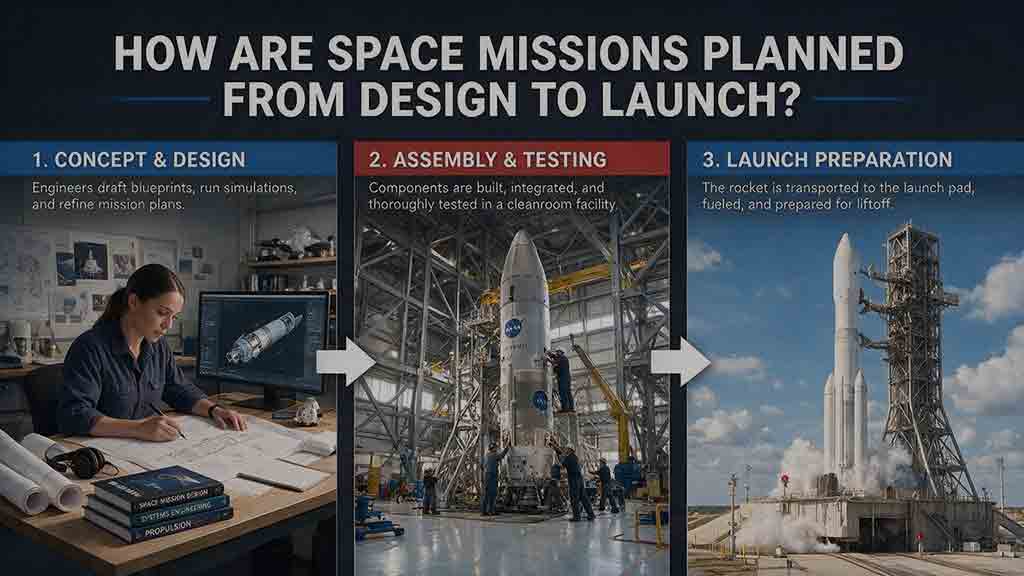
How Are Space Missions Planned From Design to Launch?
Space missions are planned by transforming a scientific, commercial, or exploration goal into a complete system that can be designed, built, tested, launched, operated, and responsibly concluded. This guide follows the full planning lifecycle, from defining measurable objectives and comparing mission concepts to writing requirements, selecting an architecture, managing resource budgets, and controlling interfaces. It explains how payloads, spacecraft platforms, trajectories, launch services, software, ground systems, regulations, and operations must be developed together. Readers will also learn how design reviews, fabrication, environmental testing, end-to-end verification, operator training, licensing, launch integration, and readiness assessments support mission development. Original planning frameworks, worked mass, power, and data calculations, troubleshooting guidance, and a practical checklist show how teams identify weak assumptions and resolve designs that do not close. The central lesson is that mission readiness depends on the entire technical and operational system—not merely on completing the spacecraft.
What Happens During a Rocket Launch Countdown?
A rocket launch countdown is far more than a clock running toward zero. It is a carefully coordinated process that brings the launch vehicle, spacecraft, ground equipment, flight teams, weather conditions, and safety range into an approved configuration for liftoff. This article explains the major countdown phases, including launch-pad preparation, propellant loading, avionics and navigation checks, weather monitoring, range clearance, go/no-go polls, and terminal count. It also clarifies commonly misunderstood terms such as T-minus, L-minus, planned hold, recycle, scrub, and launch window. An original Four-C Countdown Framework—Clock, Configuration, Constraint, and Commitment—helps readers understand why teams may continue, pause, return to an earlier step, or cancel a launch attempt. Practical timelines, comparison tables, a launch-window calculation, and a viewer’s checklist make the article useful for students, educators, first-time launch viewers, and spaceflight enthusiasts.
How Do Spacecraft Dock in Orbit?
Spacecraft docking is a carefully controlled process that begins long before two vehicles make physical contact. The approaching spacecraft must first establish compatible orbital geometry, adjust its timing through phasing maneuvers, and reduce differences in position, velocity, and orientation. This guide explains the complete sequence from far-field rendezvous and relative navigation to hold points, final approach, soft capture, and hard capture. It also compares docking with robotic berthing, examines the sensors and control systems used during an approach, and shows how mission teams respond when navigation data, closing rates, or alignment fall outside permitted limits. A simplified orbital calculation demonstrates why a spacecraft in a slightly lower orbit can gradually catch its target. Readers will also find an original five-match framework, a practical docking-safety model, real mission examples, and a checklist for evaluating docking plans. The article clearly distinguishes educational principles from vehicle-specific flight procedures and engineering requirements.
Explore More Topics
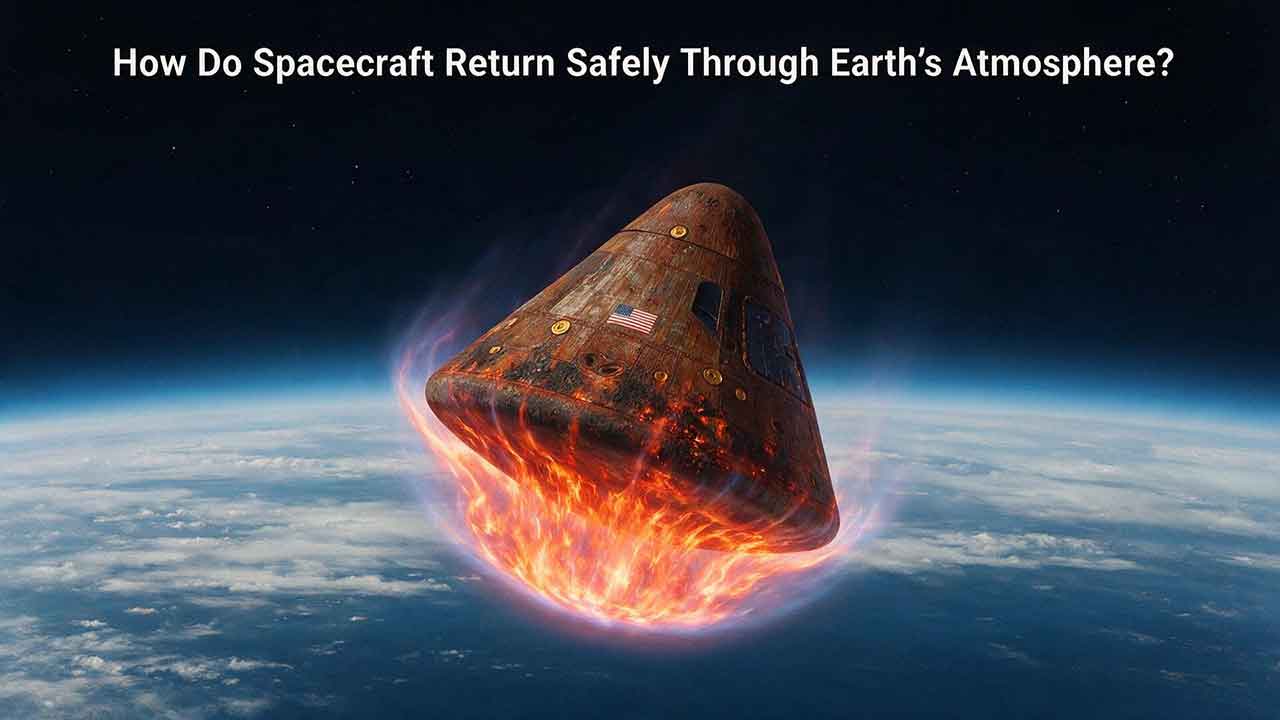
How Do Spacecraft Return Safely Through Earth’s Atmosphere?
Spacecraft return safely through Earth’s atmosphere by managing an enormous amount of energy through a carefully coordinated sequence of trajectory control, thermal protection, aerodynamic deceleration, landing, and recovery. This article explains how deorbit burns and entry corridors guide a spacecraft toward its landing region, why blunt heat shields reduce the danger of hypersonic heating, and how guidance systems control attitude, range, and structural loads. It includes an original comparison of low-Earth-orbit and lunar-return energy, a practical review of ablative and reusable heat-shield technologies, and the CosmoBasics Four-Layer Reentry Framework covering path, protection, control, descent, and recovery. Real-world lessons from Artemis I and the crewed Artemis II mission show why postflight inspection remains essential even after a successful splashdown. Readers will also learn how parachutes, wings, landing rockets, flotation systems, and recovery teams complete the return safely.
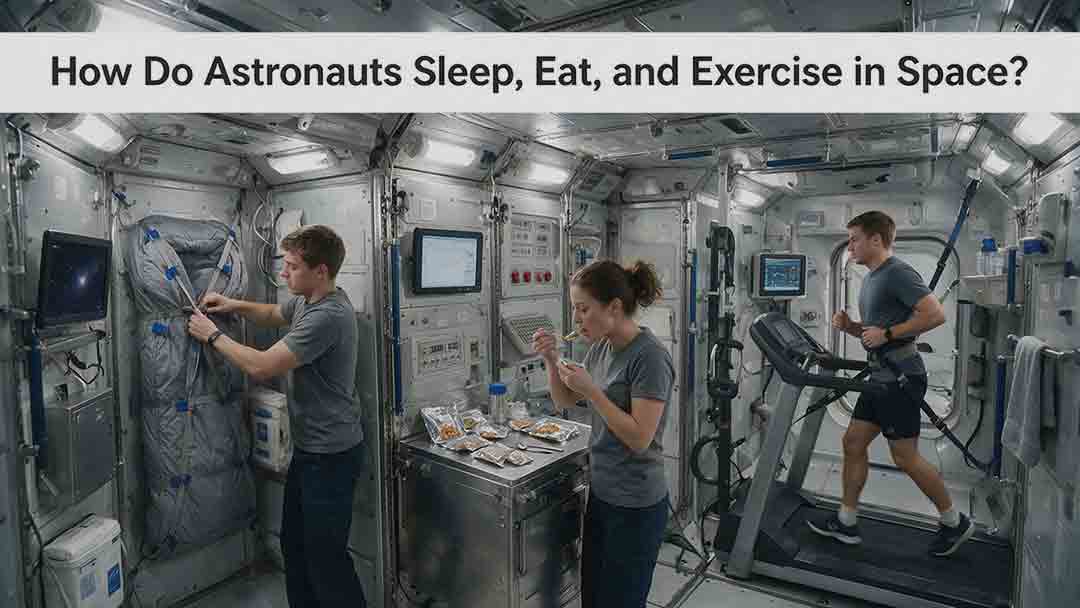
How Do Astronauts Sleep, Eat, and Exercise in Space?
Astronauts must redesign ordinary routines when they live in microgravity. This article explains how crew members sleep in secured bags inside ventilated quarters, prepare packaged meals without letting food or liquids drift through the cabin, and use specialized exercise equipment to protect their physical condition. It examines the roles of the Advanced Resistive Exercise Device, the T2 treadmill, and the CEVIS cycle ergometer, while clarifying the difference between active workout time and the full scheduled exercise period. Readers will also learn why tortillas are practical in space, how airflow affects sleep, why ordinary weights do not work normally in orbit, and how nutrition, rest, and exercise support one another. NASA and ESA sources provide the factual foundation, while original comparison tables and practical evaluation frameworks show how spacecraft systems replace functions normally supplied by gravity. The article also distinguishes current International Space Station practices from possible future Moon and Mars mission requirements.
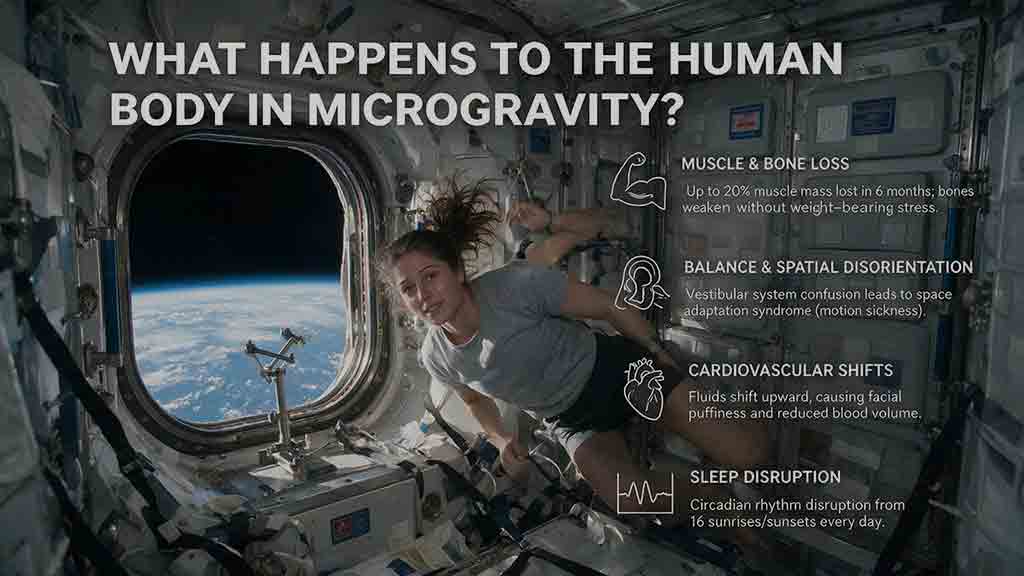
What Happens to the Human Body in Microgravity?
Microgravity changes the human body because fluids are no longer pulled toward the legs, muscles and bones receive less mechanical loading, and the brain loses gravity as a dependable orientation signal. This article explains how weightlessness affects balance, circulation, muscle strength, bone density, vision, blood, immunity, digestion, sleep, and spinal length. It also examines why astronauts may struggle to stand or walk after landing and how exercise, nutrition, monitoring, and rehabilitation help reduce these risks. Two original tools—the Load–Flow–Orientation Framework and the Gravity-Transition Readiness Matrix—connect physiological changes with real mission demands. Drawing on NASA standards, NASA technical reports, ESA materials, and peer-reviewed human spaceflight research, the guide clearly separates established observations from experimental countermeasures and unresolved questions. It also explains what these effects could mean for future missions to the Moon and Mars without treating population averages as predictions for individual astronauts.